Theodor Adorno died in 1969, long before today’s personalized feeds. Yet reading his critique of the “Culture Industry” now can feel like reading a philosophical companion to the TikTok “For You” page. TikTok describes a recommendation system that ranks videos using interactions, video information and account settings.1 Through Adorno’s lens, the promise of a feed tailored to personal taste invites a question: how much of what feels like individuality is shaped by a system for organizing and selling attention?
This essay explores that question through HUNTR/X’s “Golden” and a broader corpus of 84,816 YouTube comments associated with 15 selected songs released in 2025. Adorno’s concepts help interpret remarks about formula, branding, pleasure and production. The analysis is exploratory: it describes stored comments and finds language matching a configured vocabulary, rather than measuring listeners’ consciousness or testing the causal effects of a recommendation system. Alongside that vocabulary, selected exchanges suggest what I call “collective decoding”: audience members publicly interpreting the cultural products they consume.
The Corpus: 2025 Releases, Not All 2025 Streams
The selection criterion was the top-streamed songs first released in 2025. A song released in 2024 does not qualify, however popular it became in 2025. The repository records 15 selected titles under “Most Streamed (Spotify) Songs Released in 2025.” This is distinct from Spotify’s unfiltered Top Tracks of 2025 Global playlist, which includes older releases. The original ranking source, stream totals and selection date were not retained, so the exact historical top-15 ranking cannot be independently reconstructed. The fixed song list defines the scope of this analysis.2
The frozen merged dataset contains 84,816 distinct comment IDs across 20 video URLs. The current collection CSV lists 15 URLs, including a visualizer; five song groups have two source URLs in the merged data. Collection used youtube-comment-downloader with popularity sorting and a global 450,000-comment cap. That method does not establish complete retrieval, and the original merge history and per-video retrieval logs are unavailable. This is a stored convenience corpus, not a census of all comments or a random sample of listeners.
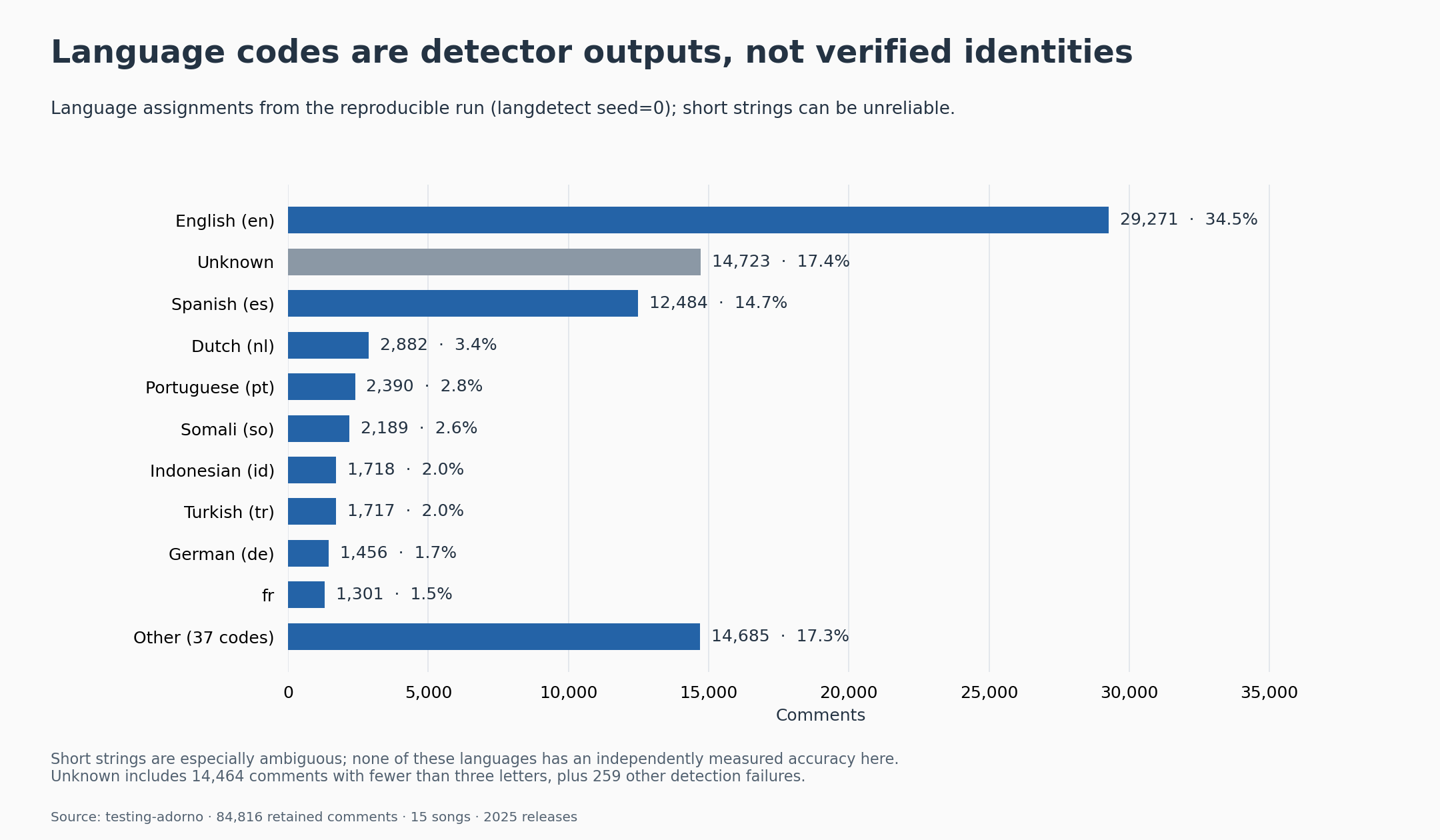
The credits include five solo Bad Bunny entries and one collaboration credited to Bad Bunny, Omar Courtz and Dei V. In the reproducible, seeded language-detection run, 29,271 comments are assigned English, 12,484 Spanish and 14,723 unknown. There are 47 categories including unknown. These are automatic assignments, not verified language identities. Short strings can receive unreliable named assignments as well as fall into unknown; 14,464 comments contain fewer than three alphabetic characters after cleaning.
Replies make up 66,766 rows, or 78.72% of the corpus. After ingestion’s newline normalization, trimming and lowercasing, 20,084 texts repeat earlier wording under separate IDs. Such repetition does not by itself establish bot activity, but replies and repeated text make independent-listener interpretations inappropriate.
Short Comments, Different Distributions
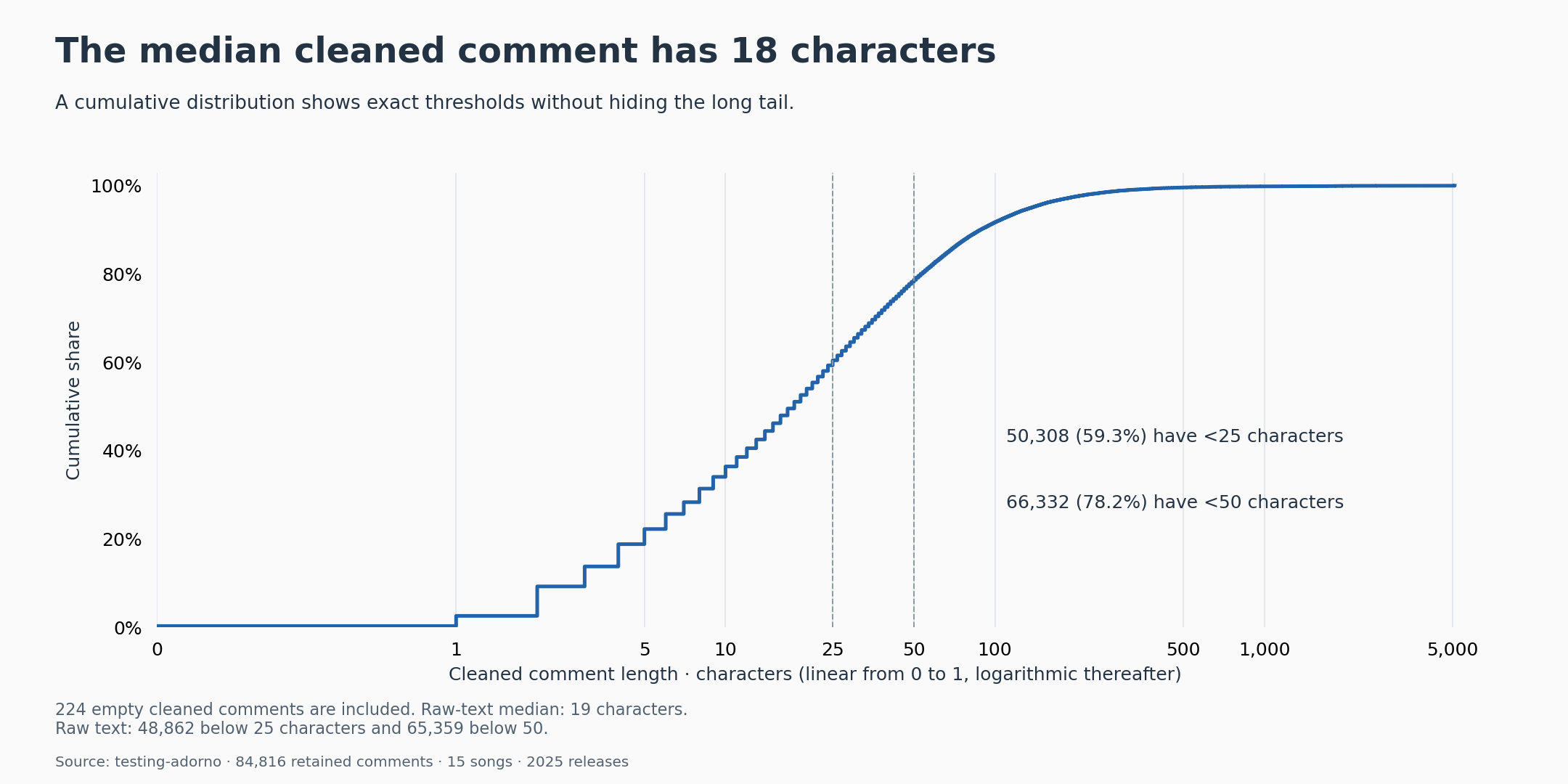
Comment length is the first descriptive check. Ingested raw text has a median of 19 characters; cleaned text has a median of 18. Cleaning normalizes Unicode and entities, removes URLs and mentions, and collapses whitespace. The mean cleaned word count is 7.69. Of the cleaned comments, 50,308 (59.3%) have fewer than 25 characters and 66,332 (78.2%) fewer than 50; the corresponding raw-text counts are 48,862 and 65,359.
The processing flag “trivial” means fewer than three alphabetic characters, not an assessed absence of meaning. It covers 14,464 comments, about 17.1%, and overlaps the short-comment groups rather than forming an additional category. Brief reactions, timestamps and emoji are prominent, but shortness alone cannot establish passive consumption.
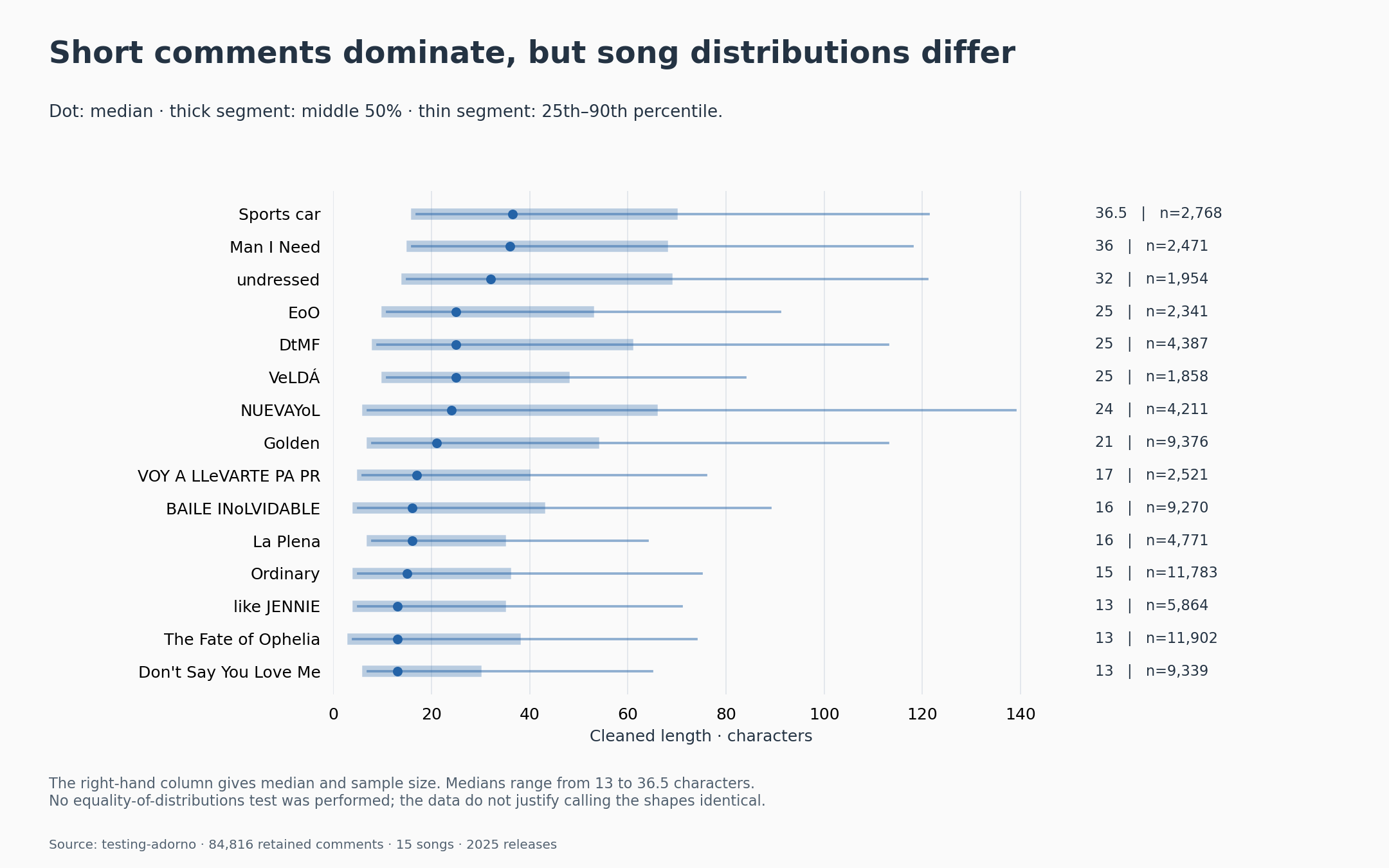
Short comments are common across the selected songs, but their proportions and upper tails differ. The earlier visual impression of similar histograms is not evidence of the same behavior across genres, languages or fanbases. No equality-of-distributions test or psychological measure was applied.
Looking for Critique
I first explored long comments and comments with many replies, expecting these to be useful places to find discussion. The historical notebook exports contain lyrics, translations, personal stories, copypasta and community-building alongside evaluations of music. These exploratory examples are not an annotated estimate of how common any response type is.
That reading motivated a lexical detector to help locate candidate remarks for closer interpretation. It does not replace reading in context: a long comment need not be analytical, and a short comment can still name a production mechanism.
Building a Rule Detector
The approach is regex-based pattern matching. Ingestion validates the schema, deduplicates comment IDs and flags emoji-only text. Preprocessing creates cleaned text, automatic language assignments and numerical features. The rule stage applies curated positive expressions and comment-wide negation suppression across six Adorno-inspired categories.
The labels are this project’s operational taxonomy, not a validated six-part instrument. FORMAL_RESISTANCE has inverse polarity: it seeks language about complexity or artistic distinction. A match is a candidate interpretation, not established counter-evidence to Adorno. The pipeline is multi-label and preserves ingested text alongside cleaned text.
| Label | Illustrative rule vocabulary |
|---|---|
| STANDARDIZATION | “all songs sound the same,” “formulaic,” “generic,” “cookie-cutter” |
| PSEUDO_INDIVIDUALIZATION | “brand over substance,” “manufactured identity,” “carbon copy” |
| COMMODIFICATION / MARKET LOGIC | “algorithm bait,” “industry plant,” “cash grab,” “made for TikTok” |
| REGRESSIVE LISTENING | “background music,” “elevator music,” “mind rot” |
| AFFECTIVE PREPACKAGING | “engineered emotion,” “fake deep,” “feel forced” |
| FORMAL RESISTANCE | “breaks the mold,” “genuine artistry,” “underrated,” “timeless” |
Illustrative English-oriented vocabulary. Rules are applied to the entire multilingual corpus, so language coverage affects the results.
Each positive pattern carries an assigned weight from 0 to 1. The legacy code calls this “confidence,” but the reported value is simply the maximum configured weight among a label’s matching patterns. No annotated evaluation set establishes calibration, precision or recall. The minimum weights and precision targets in the label configuration are not enforced or evaluated by the matcher.
Any configured negation expression anywhere in a comment suppresses the whole label, rather than just the nearby proposition. Unlisted negations can survive. For example, “The soundtrack is modern and it doesn’t feel forced” matches AFFECTIVE_PREPACKAGING through “feel forced,” reversing the expressed evaluation. Conversely, a comment describing music as “a complex commercial entertainment product” can go unmatched. Both examples show why neither matches nor nonmatches can be equated with semantic truth.
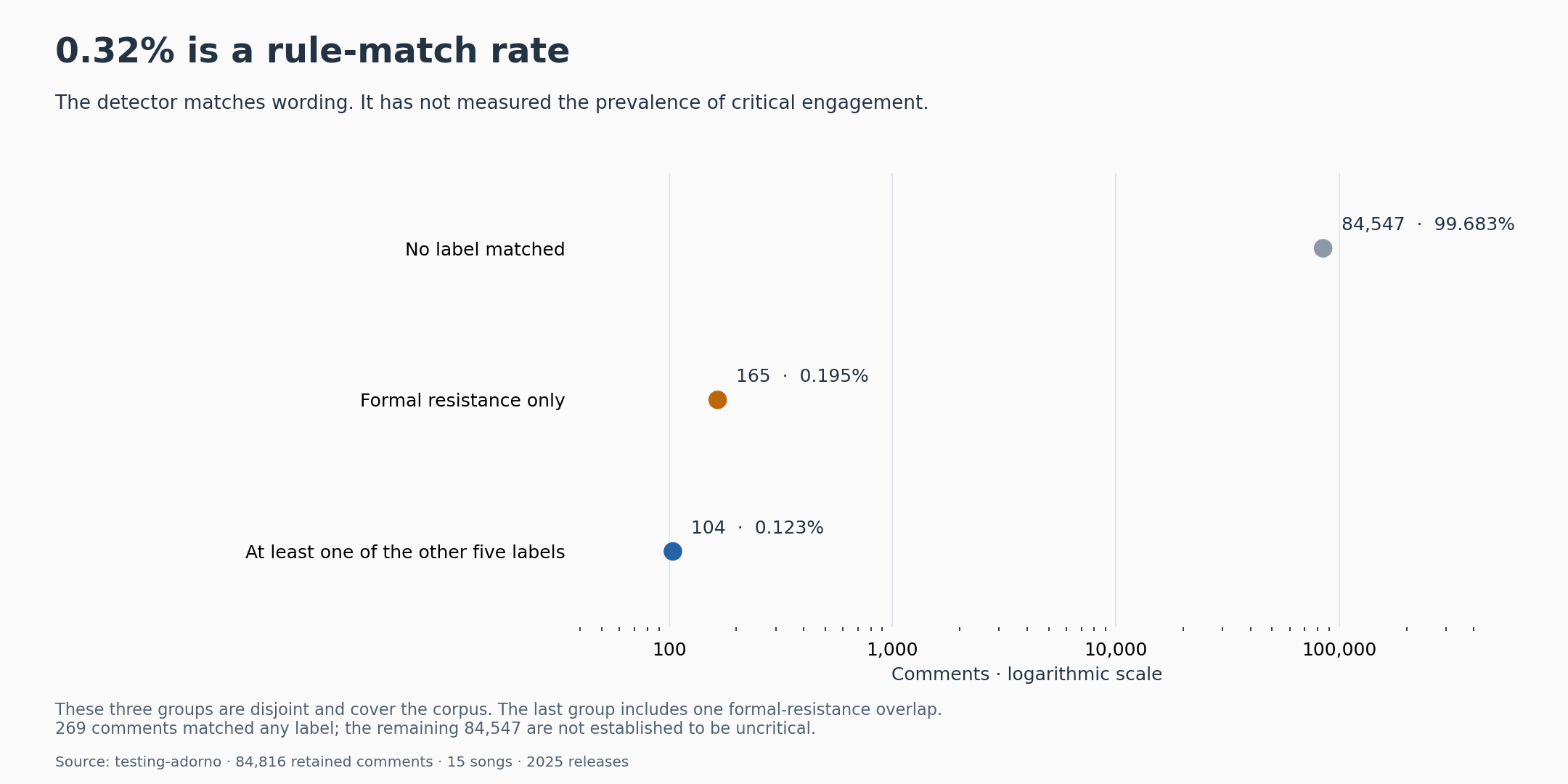
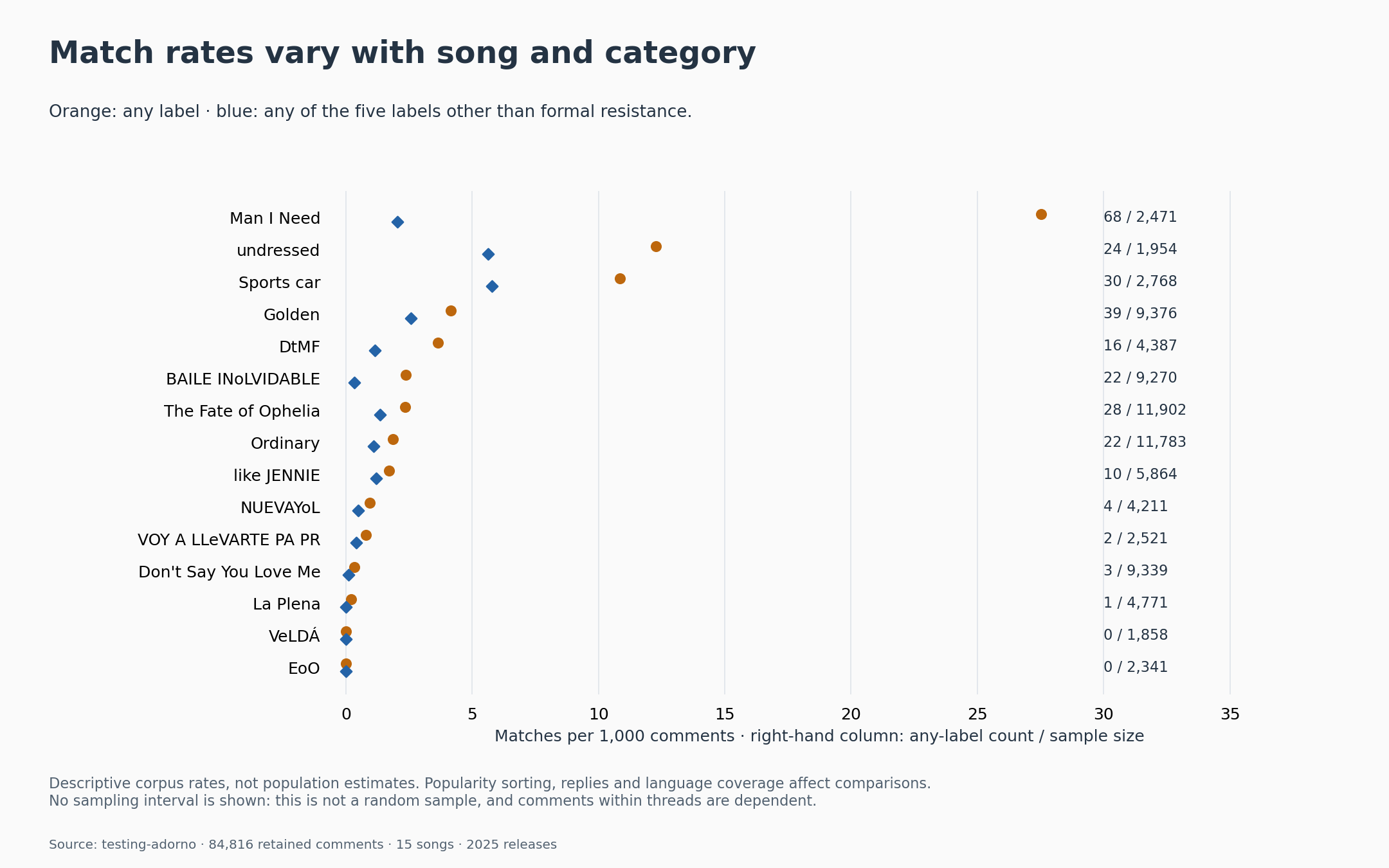
The rules match 269 of 84,816 comments: 0.3171%, rounded to 0.32%. That is a rule-match rate. The remaining 84,547 comments are not established to be uncritical or passive, and the rate is neither a validated upper nor lower bound on critical engagement.
Standardization and the Algorithm That Predicts Desire
In “On Popular Music,” Adorno describes popular music’s structure as “pre-given and pre-accepted, even before the actual experience of the music starts” (Adorno, 1941, p. 18). Individual details fit a familiar whole. His argument provides a lens for discussing interchangeability, although this project analyzes comments rather than the songs’ musical structure.
The detector finds 81 STANDARDIZATION matches, with a mean assigned weight of 0.64. Some examples do speak about formula: on Alex Warren’s “Ordinary,” “this is literally a basic radio song, is so generic” (@surferboypizza12); on Taylor Swift’s “The Fate of Ophelia,” “a generic boring comment for a generic boring song from a generic boring artist” (@dominichern9446); and on Tate McRae’s “Sports car,” “It actually sounds like generic K pop from like 5 years ago” (@azraksash). These are perceptions expressed by particular commenters, not an independent demonstration that the songs are structurally interchangeable.
On “Golden,” @The_Null_Theory writes of “purposely generic mind rot songs for children to enjoy..not because they are actually good music.” @iam1hobbit argues that “too many kpop songs today are custom built for tiktok — with choruses that are simply chanted with some viral dance move but without singing.” These remarks attribute formula to deliberate production choices. They suggest a line of inquiry about music designed for circulation, but do not establish the artists’ intentions or the platform’s effects.
Adorno’s “A Social Critique of Radio Music” also asks how distribution changes listening (1945). That concern can be extended to snippets, playlist transitions and loops. The “For You” page offers a provocative analogy: anticipated interest can become the context in which a song is encountered. This is a theoretical reading of recommendation, not a causal result from the YouTube corpus.
Pseudo-Individualization and the Illusion of Choice
Adorno defines pseudo-individualization as “endowing cultural mass production with the halo of free choice or open market on the basis of standardization itself” (1941, p. 25). A personalized feed invites a contemporary version of his question: can distinct experiences be assembled within shared commercial and stylistic constraints? The analogy does not require assuming that recommendation systems erase individuality.
The pipeline finds one PSEUDO_INDIVIDUALIZATION match: @bailee7696 on “Sports car,” “literally are carbon copy of buttons,” with an assigned weight of 0.75. This is a sparse detector output. It could reflect narrow expressions or language coverage; it cannot show that an ideology is especially effective because listeners rarely name it.
Other comments discuss corporate production and hidden creative labor. On “Golden,” @ruskiwaffle1991 writes, “Funny thing is, K-pop is one of the most corporate music genres out there.” @ZhonWeak notes that “what makes a song nice isn’t just the names on the song title, there are people not named in the title who are the very reason why the song is amazing, ie the songwriters (not the singers most of the time for commercial music) and the producers.” These examples match COMMODIFICATION / MARKET LOGIC in the code. Reading them alongside pseudo-individualization is my qualitative interpretation, not an additional classifier result.
There are 14 market-logic matches, with a mean assigned weight of 0.77, including @fonumanukeu-bv9ty’s “it was probably just a money grab.” Such remarks illustrate how commercial production can become an explicit topic of audience discussion. Their configured weights do not establish their correctness or depth.
The Passive Listener and the Echo Chamber
Adorno links standardized music to conditioned modes of listening in “On Popular Music” (1941, pp. 21–22). Recognition can displace attention to the work’s particular structure. This remains a useful critical question, but the presence of brief fan reactions cannot answer it on its own.
The rules find seven REGRESSIVE_LISTENING matches, with a mean assigned weight of 0.70. @Dr_Darrow, discussing “Ordinary,” uses phrases including “its terrible, elevator music...” and “another ordinary overprocessed pile of garbage got a bunch of listens from the mass of braindead ordinaries.” These are commenters’ accusations about listening, not observations that establish other listeners’ mental states.
Popularity sorting affects what the collector encounters. The corpus does not compare popular and chronological ordering, measure comment rank or test recommendation exposure. It therefore cannot show that YouTube promotes generic reactions while burying critique. The platform analogy belongs to the essay’s interpretation; sorting effects remain an empirical question.
What the Classifier Reveals
FORMAL_RESISTANCE has the largest rule count, at 166, followed by STANDARDIZATION at 81. Standardization leads only among the five categories other than formal resistance. Unequal vocabularies and unmeasured error rates prevent treating that ordering as the relative prevalence of the theoretical concepts.
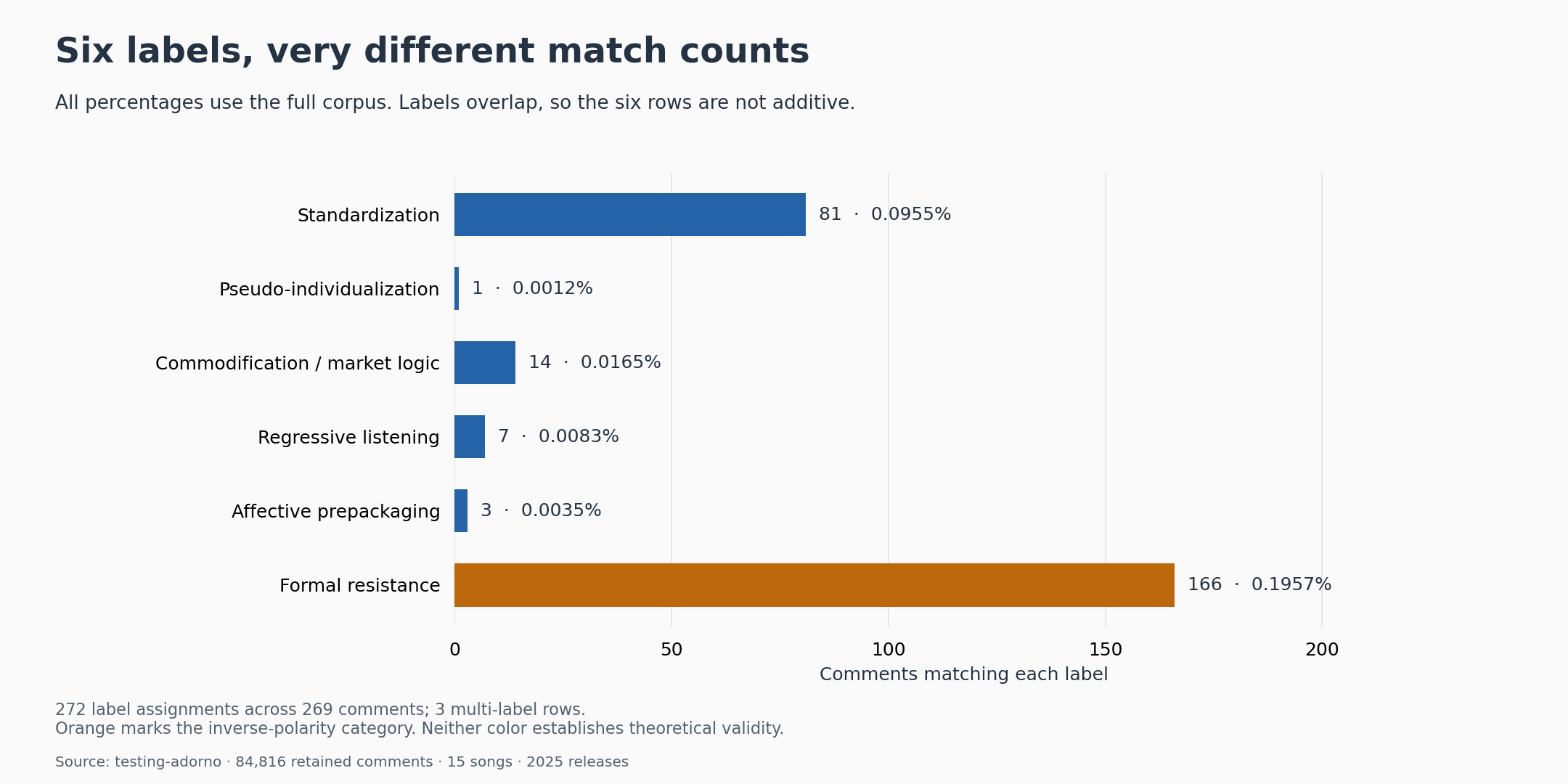
| Category | Matches | Mean assigned weight | Maximum assigned weight |
|---|---|---|---|
| STANDARDIZATION | 81 | 0.64 | 0.85 |
| PSEUDO_INDIVIDUALIZATION | 1 | 0.75 | 0.75 |
| COMMODIFICATION / MARKET LOGIC | 14 | 0.77 | 0.88 |
| REGRESSIVE LISTENING | 7 | 0.70 | 0.82 |
| AFFECTIVE PREPACKAGING | 3 | 0.67 | 0.80 |
| FORMAL RESISTANCE | 166 | 0.48 | 0.82 |
Weights describe the rule configuration, not measured accuracy. The any-label rate is 269 / 84,816 = 0.3171%.
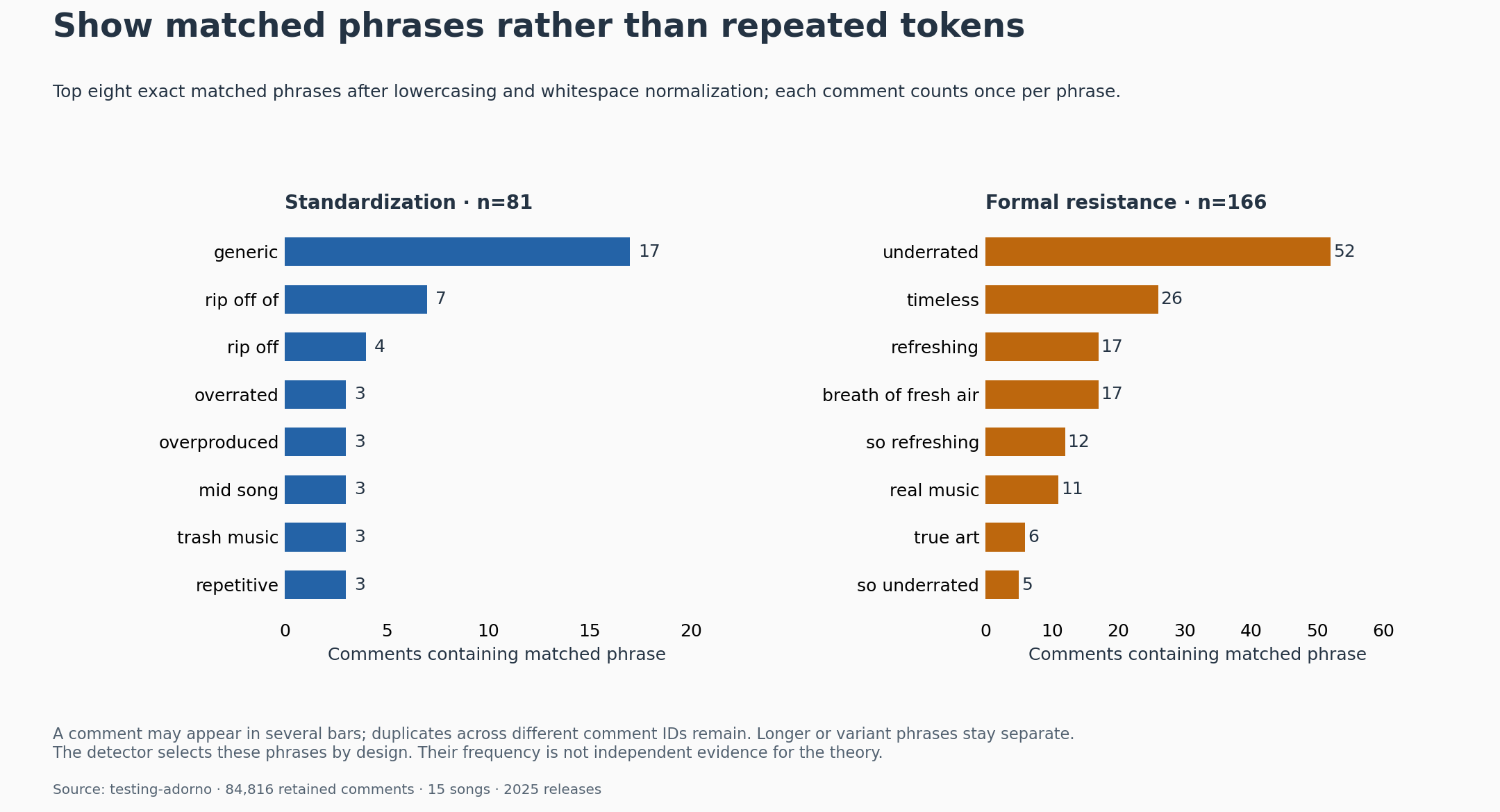
Formal-resistance matches often contain broad appreciation terms such as “underrated,” “timeless” or “refreshing.” Those expressions can praise an artist without arguing for complexity or resistance to standardization. The mean assigned weight of 0.48 reflects the pattern settings; it is not evidence of a marginally passed classification threshold. There is no applied minimum-weight filter.
The matched-phrase chart counts comments containing each exact matched phrase, once per comment per phrase. It replaces the old word-frequency plots, which counted repeated token occurrences. Longer phrases and variants remain separate, and a comment can appear in several bars. These frequencies explain what the detector selects; they are not independent confirmation of Adorno.
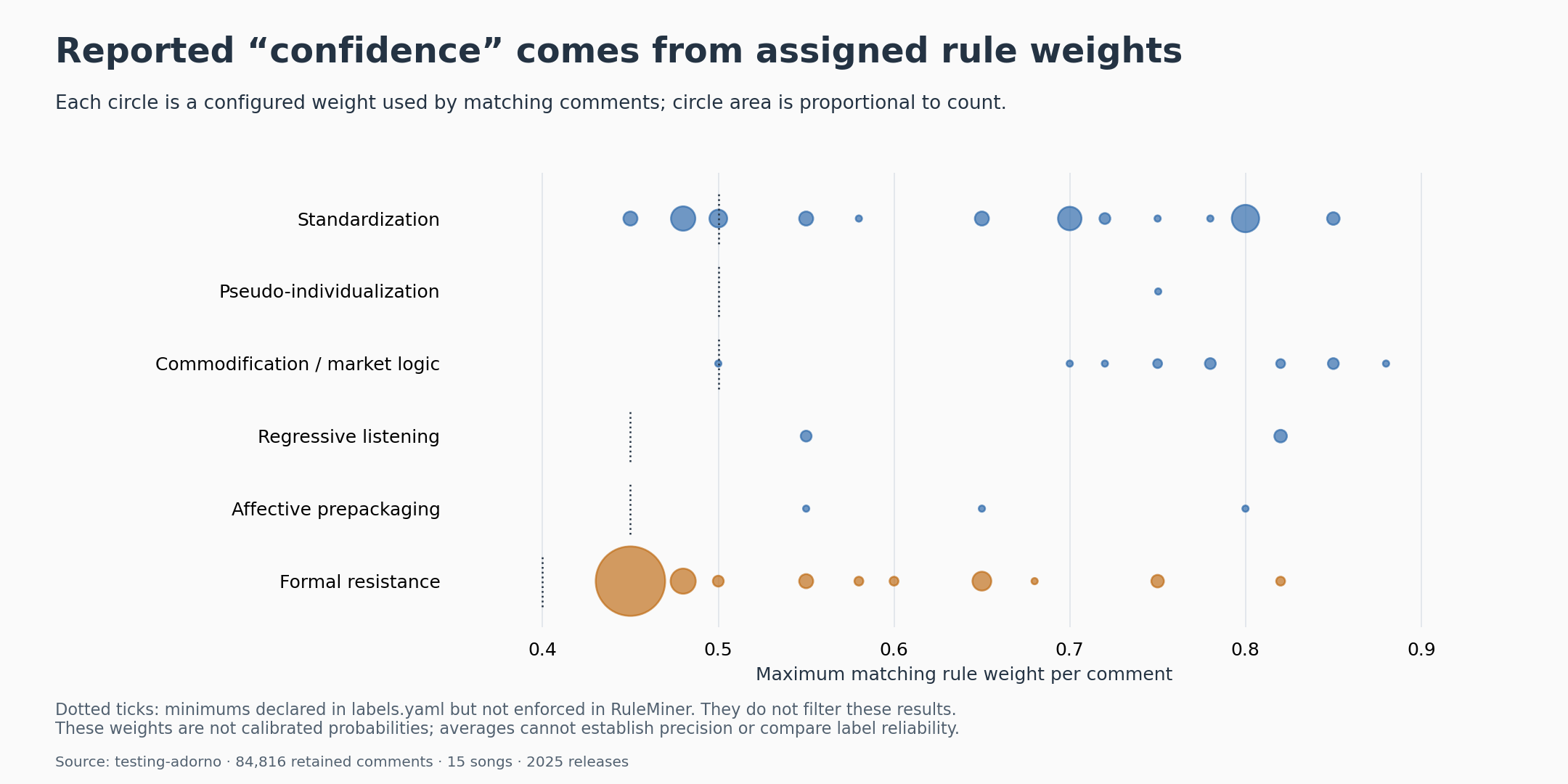
Comparing mean weights cannot establish which label is more reliable or which commenters are more precise. That would require independent annotation and evaluation.
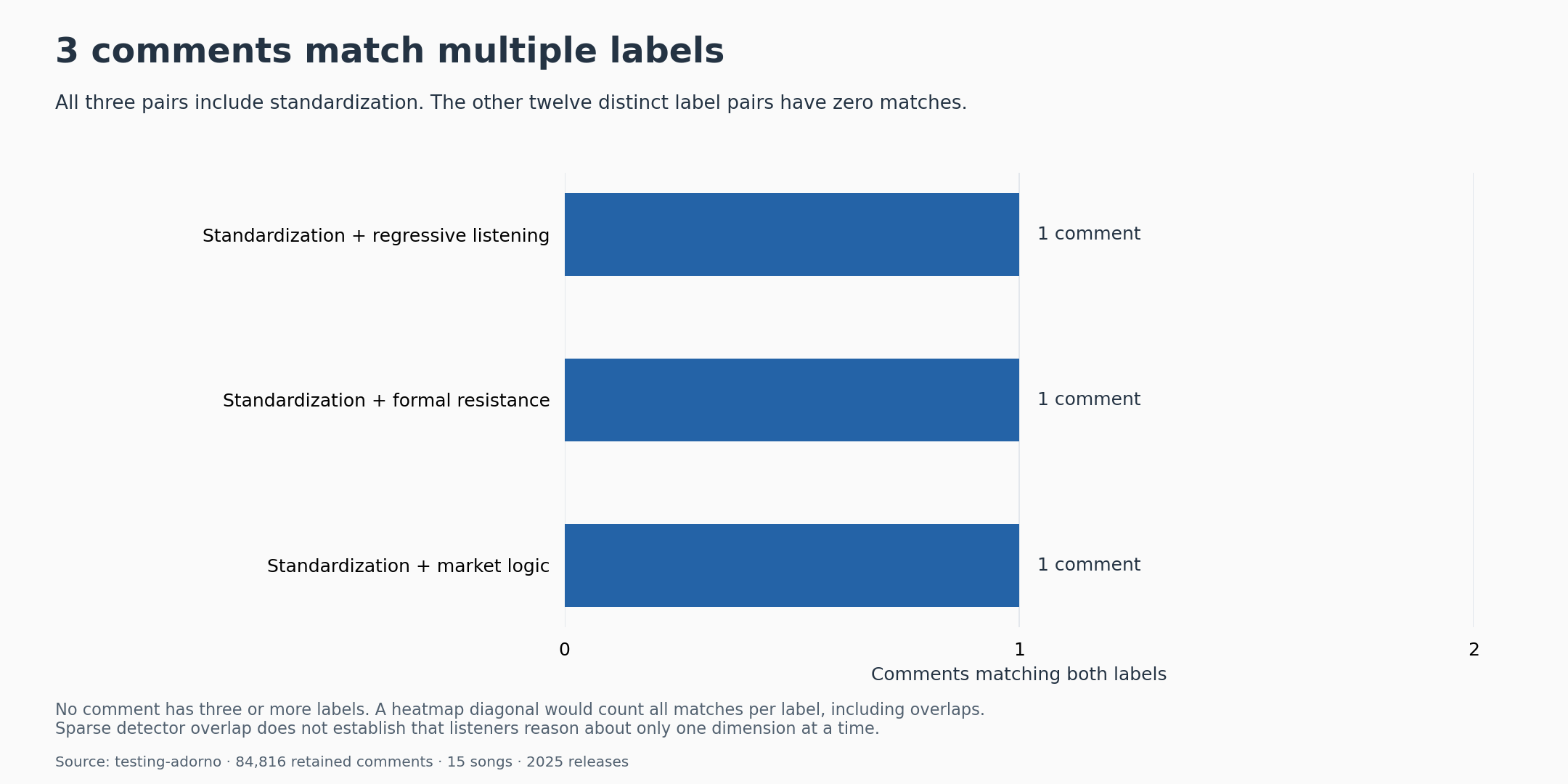
Sparse detector overlap does not establish that commenters focus on one dimension at a time. A remark can discuss several production mechanisms while using words that trigger only one category.
Collective Decoding: Reading Beyond the Rules
The most productive counterpoint to a totalizing reading of Adorno comes from particular exchanges, rather than from calling all 269 matches acts of critique. Some commenters discuss the apparatus behind a song and question one another’s evaluations. These examples support a qualitative argument about public interpretation; they do not measure how widespread it is.
Under “Golden,” @ivobaki3751 writes: “I know how things are behind curtains in kpop world and as they sing lovely like angels everything i know makes me more resistant to its influence. Kids went bzrk about them and im sure these ladies good persons and all but the industry that generated entire show is what it is. Ive seen same pattern repeat too many times.”
I read this as connecting repeated production patterns with a conscious effort to resist their appeal. The detector labels it standardization. My broader reading extends beyond that lexical output; the comment gives no basis for inferring whether its author has encountered Frankfurt School theory.
@sandyg4646 challenges another user: “k pop is extremely formulaic in its approach despite the mixing of different styles. You said it yourself ‘more focus on choreography and stage presence’ what does that tell you?” The question makes critique conversational rather than merely an isolated declaration of taste.
On sombr’s “undressed,” @estuchedepeluche2212 writes: “Derivative, not quite original, familiar, comforting, but oh, so good. As Umberto Ecco said: ‘The cliches are talking and they are having a ball!’” The spelling and attribution are the commenter’s. The code matches standardization here, not formal resistance. Qualitatively, however, the remark holds pleasure and criticism together, complicating any simple division between critical and regressed listening.
That is what I mean by collective decoding: audiences can use the same public spaces that circulate cultural products to discuss their construction and value. Selected remarks illustrate the possibility. A systematic study of thread interaction would be needed to establish its prevalence or its collective effects.
Conclusion
Adorno’s account remains a powerful way to ask how commercial systems organize culture and listening. The examples here show that formula, branding and production can become objects of explicit audience discussion, while pleasure and criticism can coexist.
The reproducible finding is narrower: English-oriented rules match 269 of 84,816 stored comments associated with 15 selected songs released in 2025. The 0.32% does not estimate critical engagement, listener passivity or the success of an ideology. Unit tests and notebook audits establish computational consistency; semantic validation would require an annotation rubric, multilingual review of matches and nonmatches, and measured agreement, precision and recall.
The public critique beneath “Golden” is worth reading without making it stand for every listener. A platform can distribute commercial culture and host interpretations that question it. That the culture industry might generate conditions for its own critique remains, in the end, an Adornian irony worth pursuing.
Works Cited
- Adorno, T. W., with Simpson, G. (1941). On popular music. Studies in Philosophy and Social Science, 9(1), 17–48. https://ctwgwebsite.github.io/assets/pdf/zfs/adorno-simpson-pop-music.pdf
- Adorno, T. W. (1945). A social critique of radio music. The Kenyon Review, 7(2), 208–217. https://kenyonreview.org/kr-online-issue/weekend-reads/t-w-adorno-656342-2/
- TikTok (2020). How TikTok recommends videos #ForYou. https://newsroom.tiktok.com/en-us/how-tiktok-recommends-videos-for-you
- Spotify (2025). The top artists, songs, albums, podcasts, and audiobooks of 2025. This ranking covers streams during the year rather than only 2025 releases. https://newsroom.spotify.com/2025-12-03/wrapped-top-artists-songs-albums-podcasts-audiobooks/
- Analysis code, frozen corpus and song metadata: https://github.com/LuizFelipeBarbosa/testing-adorno
Notes
-
TikTok’s explanation of its recommendation factors: https://newsroom.tiktok.com/en-us/how-tiktok-recommends-videos-for-you. The YouTube corpus does not test that system. ↩
-
The frozen dataset, selected song list, pipeline, notebook and reproducible chart code are available at https://github.com/LuizFelipeBarbosa/testing-adorno. The ranking snapshot and original merge history are not retained. ↩