"Middle out and bottom up," exclaims Joe Biden. In 5 words, the president encapsulates a potent paradigm shift in America's economic vision. In contrast to the "trickle-down" economic policies that dominated the end of the 20th century, Bidenomics sets the stage for a renewed focus on average Americans. Recognizing the importance of blue-collar Americans, as stated in the official White House website, Bidenomics aims to make "smart public investments in America," empower and educate "workers to grow the middle class" and promote "competition to lower costs and help entrepreneurs and small businesses thrive."1 In essence, the Biden administration is envisioning a world where economic prosperity is not a privilege of the few but a right and reality for the many.
Based on this progressive economic plan, it is clear that the measures proposed under Bidenomics are not just short-term fixes but are instead crafted to ensure the United States’ long-term prosperity. So what is Bidenomics, and how is President Biden influencing the economy?
To answer this question, we must first understand that throughout American presidential history, economic policies have always reflected their time. From Franklin D. Roosevelt’s (FDR) New Deal to Ronald Reagan's Reaganomics the economic decisions of the presidency have been heavily influenced by the dominant ideologies of each era. Nowadays, with the aftermath of the COVID-19 pandemic, problems such as wealth inequality and calls for climate action are at the forefront of political discourse. Championing the economic needs of everyday Americans, Bidenomics offers a robust framework for sustainable economic growth and long-term prosperity, possibly redefining the economic future of the United States.
Examining the intricacies of Bidenomics, this research paper seeks to investigate the essence of the doctrine by first understanding the role of the president in the economy. Then we will answer the question "What is "Bidenomics?" and tackle the actions, implementation challenges and critiques of the Biden-Harris administration's economic policies. Lastly we will focus on the implications Bidenomics has for the future of the American presidency.
Economist-in-Chief
In the United States government, the president plays the role of Economist-in-Chief. As lead economist, the president is responsible for proposing and implementing economic policies, responding to economic crises, promoting economic growth, shaping public perception, and managing international economic relations. These responsibilities give presidents considerable power over the country's economy, allowing them to address economic problems of the past, present, and future.
One of the main functions of the presidency, when it comes to the economy, is proposing and implementing economic policies. By proposing budgets to Congress, the White House manages the government spending in three areas: "Mandatory spending (funding for Social Security, Medicare, veterans benefits, and other spending required by law), discretionary spending (funding for federal agencies), and interest on the debt."2 By controlling government expenditure, the executive can allocate funding to the most pressing economic policies, prioritizing them and streamlining execution. Furthermore, the president is tasked with appointing individuals to key economic positions, such as the Treasury Secretary and the Federal Reserve Chair.3 These agencies cooperate and advise the president on economic decisions by helping the White House pursue economic policy and maintain economic stability.
With the ability to outline government spending plans by allocating resources and setting economic priorities, the president has broad power to influence the country's economy. These powers allow the president to respond to economic crises quickly. By implementing stimulus packages (for example, stimulus checks extending unemployment benefits, moratoriums on evictions and foreclosures, and child tax credits)4 and coordinating with the Federal Reserve while reassuring the public during economic downturns, the president can lessen the impact of an economic crisis.
Another significant role of the Economist-in-Chief, often emphasized during economic downturns, is promoting economic growth. The president can work to enhance the country's overall productivity, innovation, and competitiveness through long-term investments in infrastructure, education, and research and development. Furthermore, to elevate the success of these policies, the White House plays a significant role in shaping public perception of the economy. Utilizing strategies such as expressing optimism, outlining economic plans, and addressing the public's economic concerns, they are able to maintain public confidence and stability of the economy.
Last but not least, the president manages international economic relations by engaging with foreign leaders and participating in international economic forums. The president works to address global economic issues and promotes international stability and cooperation. The administration can also create foreign economic policy through coordination with other nations, promoting fair trade practices, negotiating trade agreements, and creating new markets for American goods.
These duties give the president broad power to dictate the country's economic future, which has led to various economic doctrines over the past 100 years.
Influential Presidential Economic Doctrines
Responding to the economic crisis of the Great Depression, President Franklin D. Roosevelt (FDR), guided by economists like Adolf Berle, enacted an approach targeted at reducing the economic power of a "small and elite group of men."5 A number of initiatives in infrastructure development, financial reform, and regulation were created, known as the New Deal. These measures aimed to provide immediate relief to the unemployed, stimulate economic activity, and restructure the financial system. Through the Public Works Administration, the New Deal worked to employ millions of jobless Americans. It facilitated the creation of large-scale public works projects such as the Hoover Dam, Lincoln Tunnel, and Airports all over the United States.6 Furthermore, the Social Security Administration worked to establish social welfare programs such as social insurance consisting of social security unemployment and retirement benefits to provide a safety net for the vulnerable.7 Lastly, he created regulations for the financial industry, such as the Securities Exchange Act of 1933/34, to prevent future economic meltdowns.8
In contrast to FDR's interventionist approach, President Ronald Reagan advocated for a laissez-faire economic philosophy known as supply-side economics. This theory held that reducing taxes on businesses and individuals would stimulate economic growth by increasing investment and productivity. By implementing significant tax cuts for corporations and individuals through the Economic Recovery Tax Act of 1981 and the Tax Reform Act of 1986, Reagan aimed to reduce business costs and give individuals more disposable income.9 Moreover, Reaganomics championed the deregulation of various industries to reduce government interference in the market by, for example, "removing price controls on oil and gas, reducing restrictions on the financial services industry, and relaxing the enforcement of the Clean Air Act."10 Deregulation aimed to lower industry barriers to entry, allowing small business growth and increasing competition. Lastly, he advocated for fiscal responsibility focused on decreasing federal spending on social programs such as Social Security, Medicaid Food Stamps, and Education.
What is Bidenomics?
The core tenets of Bidenomics are making "smart public investments," "empowering and educating workers" and "promoting competition."11 Through this philosophy, Bidenomics seeks to generate a multiplier effect. By allowing individuals to access high quality infrastructure, education, healthcare, and affordable housing paired with the government promoting competition and small business growth. As their circumstances improve, they tend to spend more and invest in their communities, stimulating new businesses and investments, improving communities around the United States, fostering a virtuous cycle.
Empowering Blue-Collar Americans
The middle class has long been the bedrock of the American economy, representing a significant portion of the workforce and the primary driver of consumer spending.12 However, as shown by the Economic Policy Institute, in recent decades the middle class has shrunk, mainly due to stagnating wages, with many individuals struggling to keep up with a rising cost of living.13 This statistic is further reinforced as according to the World Bank since the 1980s the GINI index14 has been rising meaning the wealth gap between the richest and the poorest has been widening. With many companies moving their manufacturing operations abroad, globalization and technological advancements have exacerbated this inequality.
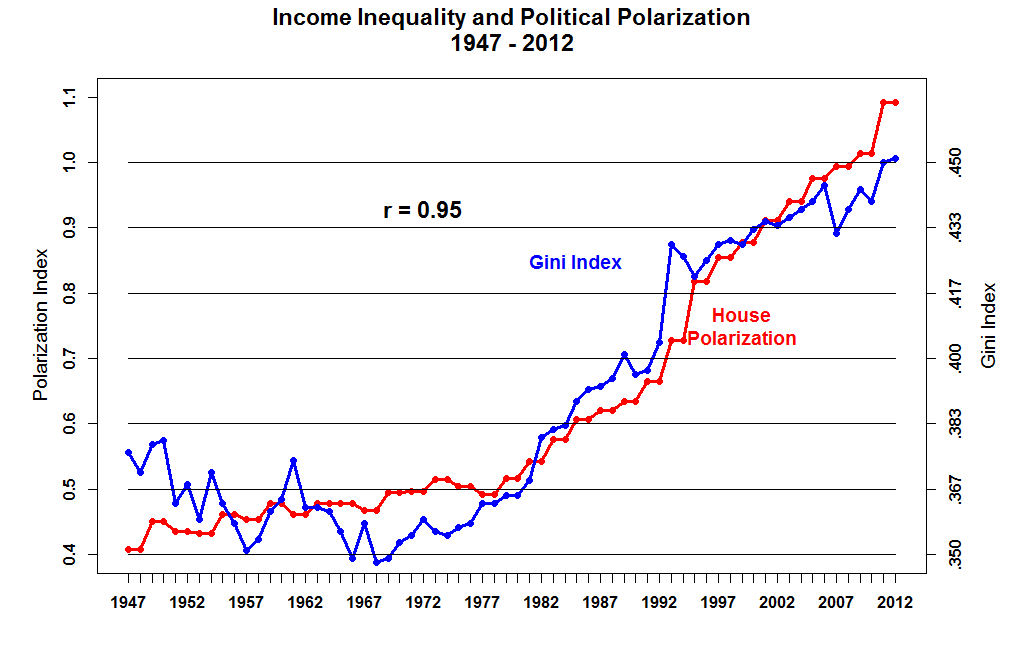
The decline of the middle class and subsequent rise in inequality have had a detrimental impact on American society. As shown in the book "Polarized America: The Dance of Ideology and Unequal Riches," there is a strong correlation between wealth inequality and rising social and political tensions measured by polarization in recent times (Figure 1).15 Recognizing the importance of the middle class, the Biden administration has strongly emphasized middle-class growth in its economic doctrine.
The Biden administration’s focus on middle-class growth stems from the belief that a robust middle-class leads to a more equitable and prosperous society. Bidenomics aims to create favorable conditions for middle-class individuals by implementing policies that promote job creation, increase wages, and expand access to affordable healthcare. This approach recognizes that economic prosperity is not solely achieved through top-down policies like those in the 1980s but requires investments in individuals and communities that have been historically disadvantaged. These policies, similar to the National Industrial Recovery Act of 1933 during FDR’s New Deal, aim to empower the population from the bottom up by creating jobs and increasing worker productivity and expertise.
Investing in Semiconductors and Clean Energy
In order to fulfill the goal of empowering middle and lower-class Americans, Bidenomics is investing in semiconductors and clean energy all over the country. A critical component of the modern economy, the semiconductor powers everything from computers to smartphones to cars and medical devices. In addition, green energy is another area where Bidenomics emphasizes investment, aiming to transition the United States to a more resilient and sustainable energy future. Investing in these two industries will not only create multiple high-paying jobs while bolstering American manufacturing and reducing reliance on foreign suppliers but will also strengthen the green energy sector creating high-paying jobs and reducing greenhouse gas emissions, combating climate change.
Due to the COVID-19 pandemic national security concerns and potential disruption in the supply chain highlighted the need for strengthening domestic semiconductor manufacturing capabilities, reducing reliance on foreign suppliers. This pressing need for computation chips is the main driver behind this initiative. Bidenomics will create high-skilled, high-wage manufacturing, engineering, and research and development jobs by investing in domestic semiconductor manufacturing.1617 These investments will contribute to the multiplier effect, potentially sprouting innovation and technological advancements, bolstering nationwide American manufacturing. Securing the supply of essential components for American industries and consumers, these investments aim to revitalize the American middle class and ensure that the United States is at the forefront of technological innovation.
Furthermore, the transition to clean energy is not just environmental, it also presents significant economic opportunities. Investing in clean energy technologies like solar, wind, and battery storage will create many well-paying manufacturing, installation, and maintenance jobs. These jobs require a skilled workforce, creating opportunities for middle-class individuals to transition to new careers in the green energy sector.18 Investing in clean energy will reduce reliance on fossil fuels and mitigate climate change, positioning the United States as a leader in the global clean energy economy.
Promoting Competition
The erosion of competition in the American economy has been a major contributor to the decline of the middle class. As stated by the White House, “over the last several decades, as industries have consolidated, competition has weakened in too many markets.”19 This trend has exacerbated economic inequality.
Concentration of market power can have detrimental impacts on an economy. Companies with limited competition have no incentive to innovate, as consumers have few alternatives. Furthermore, with actions such as predatory pricing, companies with too much market power can outcompete smaller businesses. Lastly, a lack of competition means companies have more power over workers, leading to lower wages and worsened working conditions.20 This leads to reduced consumer choice, higher prices, and lower wages hindering economic growth and opportunity.
Recognizing the detrimental impact of market concentration, the Biden administration has made promoting competition central to its economic agenda. By increasing competition in key industries, such as technology and healthcare, consumers benefit from lower prices, better quality goods and services, and more innovative products. Furthermore, competition means workers will have more bargaining power and be able to negotiate for higher wages and better working conditions. This approach aims to level the playing field for small businesses, empower consumers and encourage business growth expanding the American economy fairly and equitably.
Taxes
Throughout the Biden administration the president has constantly echoed the phrase that there is a pressing need for corporations and the wealthiest individuals to “start paying their fair share” of taxes.21 Bidenomics follows this sentiment and advocates for tax increases for corporations and high-income. These tax increases aim to fund social programs and reduce the national debt.
Implementing Bidenomics
One of the Biden administration's first significant economic and legislative triumphs was the American Rescue Plan Act of 2021. A $1.9 trillion stimulus package, the plan provides stimulus checks for individuals, financial assistance for businesses in the form of grants and loans, an increase in the child tax credit, and lowered health insurance premiums to help uninsured individuals.22 Continuing the trend of interventionist government policy, another success of the Biden Administration was the Bipartisan Infrastructure Investment and Jobs Act of 2021. This $1.2 trillion bill aims to upgrade and repair infrastructure while addressing climate change. The plan allocates funds to repair and upgrade infrastructure such as roads, bridges, public transit systems, and airports. Furthermore, it focuses on expanding broadband internet and passenger rail, constructing a nationwide network of electric vehicle chargers, and replacing lead pipes to increase access to clean water.23
These legislative successes in 2021 serve as the backbone of Bidenomics, marking some of the most significant successes in executing the Doctrine. However, one of these initiatives stands out: the most successful policy implemented by the Biden administration was the temporary increase of the Child Tax Credit. According to the Columbia University Center on Poverty and Social Policy, this initiative was able to help "61.1 million children in October [2021]" and "kept 3.6 million children from poverty… a 4.9 percentage point (28 percent) reduction in child poverty"24 if the policy had not been in place. Furthermore, research on the Child Tax Credit conducted by the Urban Institute found that "Making these changes permanent would decrease child poverty (as measured by the Supplemental Poverty Measure) more than 40 percent in a typical year, meaning 4.3 million fewer children would be in poverty."25 Even though this initiative was highly successful, it ended in 2021 due to disagreements in the House of Representatives.
Following the policy successes of 2021, another measure named the Build Back Better Act of 2021 was introduced to further the Bidenomics agenda. However, the plan was criticized by stakeholders, including Republicans and Democrats in the House of Representatives, who are opposed to increases in government spending and taxation. For example, there was substantial opposition to increasing the corporate tax rate from 21% to 28%. Some critics warned that such a tax rise could harm U.S. competitiveness and slow economic growth.26 However, this tax hike was a significant component of Build Back Better. By closing corporate tax loopholes27 and raising the corporate tax rate, the proposal is expected to raise $2 trillion in tax revenue over the next 15 years—paying for bill in the long term. Another significant source of controversy was the expense of the expanded Child Tax Credit. Even though the policy had been highly effective in lowering child poverty, it was met with strong resistance in the Senate from Republicans and conservative Democrats such as Joe Manchin.28
Initially, with a projected budget of $3.5 trillion, Build Back Better was ultimately reduced to $2.2 trillion during the legislative process. Nevertheless, requiring the 50 democratic senators to vote in favor of the bill, Senator Joe Manchin withheld his vote as he claimed the bill “irresponsibly adds to our nearly $29 trillion in national debt.”29
In response to the challenges of inflation and the national deficit, after continued negotiations between members of the Senate,30 a compromise for Build Back Better, called the Inflation Reduction Act of 2022, was reached. The bill aims to “create clean energy jobs”, “make the tax code fairer”, “revitalize american manufacturing” and “lower health care costs.”31 Furthermore, by creating jobs, closing tax loopholes and increasing healthcare accessibility these policy initiatives reduce unemployment and improve the quality of the workforce, leading to a reduction inflation and the debt.
Working to further the Bidenomics agenda, in 2022, the CHIPS and Science Act was signed into law aiming to “Bolster U.S. leadership in semiconductors”, “Catalyze regional economic growth and development” and “Provide STEM opportunities to more of America to participate in good-paying skilled jobs.”32 This policy has the goal of strengthening the nation's manufacturing industry by bringing semiconductor research and manufacturing to U.S. soil creating many technology and research hubs all over the country.33 Most recently the Fiscal Responsibility Act of 2023 was passed to avoid a potential debt default introducing spending restrictions and work requirements for Americans receiving food aid.34
In addition to passing laws the Biden administration has used executive orders extensively to achieve the goals of Bidenomics. On his first day as president, Biden signed an executive order to join the Paris Climate Agreement, reversing the Trump-era policy.35 With another order, he canceled the Keystone XL Pipeline project.36 These actions show that the administration is taking responsibility for addressing climate change, furthering Bidenomics' climate agenda.
To tackle the public health and safety crisis caused by the COVID-19 pandemic, the president utilized executive power to assist the government's efforts. The executive orders ensured a fluid, coordinated approach to meeting Bidenomics' goals and assisting with the crisis by speeding up vaccine distribution, making health care more affordable, and strengthening U.S. supply chains.37 Furthermore, the COVID-19 crisis brought significant economic struggles for Americans. Recognizing this financial burden, Biden used his powers to provide student debt relief, halt federal student loan payments, and stop interest growth.38 This aid helps millions of Americans struggling with education costs, strengthens the middle class, and empowers people from the bottom up.
According to a Beacon Research/Shaw & Company Research for Fox News 62% of respondents support some kind of student debt forgiveness.39 Nevertheless, even though the policy is a popular one, the order has been held up as “Republicans and conservative groups have now brought at least six lawsuits against the president’s plan.”40 Currently, stuck in the courts the administration has stopped accepting new applications for student debt relief while the legal challenges remain unresolved.41
Highlighting the Biden administration's support for labor unions and fair labor practices, the president issued an executive order on "Worker Organizing and Empowerment."42 This order symbolizes Bidenomics' shift toward worker-related policies that strengthen labor rights and enhance working conditions.
To promote competition, in 2021, President Biden signed the “Executive Order on Competition.”43 This order symbolizes a break from the weak enforcement of antitrust laws of previous administrations. By enforcing antitrust laws, the administration aims to prevent anti-competitive mergers and business practices, and by appointing regulators committed to fair market competition, the administration strives to foster a more competitive environment in the United States. Lowering overall prices and increasing worker bargaining power.
Bidenomics by the Numbers
Initially, a term created by the media as a satiric joke to describe the economic policies of the Biden administration, Bidenomics has been adopted as official terminology by the White House.44 While some praise its policies for focusing on economic recovery and job creation, according to a poll from The Associated Press-NORC Center for Public Affairs Research, "only 36% of U.S. adults approve of Biden's handling of the economy,"45 as of August 2023. Critics of Bidenomics have raised several concerns about the potential impact of his policies.
Conservative critics of Bidenomics argue that increased government spending will generate inflationary pressure on the economy, leading to decreased economic growth.46 In fact, Inflation reached a 40-year high of 8.9% in June 2022 but currently stands at 3.6% as of October 2023.47 Furthermore, they warn that in the long run, his policies may lead to a stagflationary environment like in the 1970s, as he is too focused on income redistribution, stifling innovation and economic growth.48
On the other hand, progressive critics of Bidenomics argue that its policies do not go far enough. They claim the Biden administration must do more to address the underlying causes of economic inequality, which, according to the World Bank, the GINI index has risen since the 1980s, going from 34.7 in 1980 to 39.8 in 2021.49 Moreover, they state that his policies are too accommodating of corporate interests, failing to protect workers' rights.50 Lastly, many criticize Biden's approach to tackling the urgent climate crisis adequately, where according to the Center for Biological Diversity he "approved 6430 permits for oil and gas drilling on public lands in its first two years,"51 a decision that many view as contradictory to his environmental promises.
Advocates of Bidenomics argue that his policies have positively impacted the economy; for example, GDP growth has exceeded expectations, and unemployment has fallen near pre-pandemic levels. The economy has added millions of jobs, and the current October 2023 unemployment rate stands at 3.9%, down from 6.3% in January 2021.5253 In addition, GDP growth has remained high; according to the World Bank, in 2021, the U.S. GDP grew by 5.9%, and in 2022, a further 2.1%.54 Also, the International Monetary Fund has predicted that the U.S. GDP is expected to grow another 2.1% in 2023.55 Another essential metric to consider is that according to Statista, as of October 2023, average hourly earnings have risen by 5.2% since January 2020.56
Implications for the Future of the American Presidency
Bidenomics has the potential to establish many precedents and alter the trajectory of the American presidency. One such example is Biden's broad use of executive orders; he used them to reverse the Trump-era policy of withdrawing from the Paris Climate Agreement and providing student debt relief. This might pave the way for future presidents to use executive action more vigorously to pursue environmental and economic agendas.
Furthermore, the American Rescue Plan is another good case study that has the potential to set future precedents. The plan included funds for stimulus checks, vaccine distribution, increased healthcare access, and extended child tax credits, drastically reducing income disparity in the U.S. Future presidents may look to these actions as a model for handling economic crises and using fiscal policy to reduce social disparity.
Not only can economic theories shape the course of future economic policy but they also have a significant impact on the legacy of a president. The effectiveness of programs such as the American Rescue Plan in promoting economic recovery amidst the COVID-19 pandemic will play a vital role in evaluating Biden's economic leadership. If Biden's efforts to promote renewable energy and infrastructure are successful, they will leave an indelible impression on the American economy and his presidency. Moreover, suppose his actions to address economic inequality—such as expanding child tax credits and working to raise the federal minimum wage—actually result in quantifiable decreases in poverty. The outcome of these policies will be vital in determining the success of Bidenomics.
In layman's words, Biden will be recognized as a successful president if Bidenomics results in economic growth and a subsequent period of prosperity. However, he will most certainly be regarded as a president who failed if his policies cause economic trouble. Nevertheless, how exactly Bidenomics will affect the U.S. presidents in the future is anybody's guess; what is clear is that the outcome of his policies will have a significant influence on the economy in the long run and transform the debate between trickle-down vs. bottom-up economic policies.
Significance
Bidenomics is of extreme significance in our modern world. It is a doctrine that can potentially restructure the United States' economic future. It will also play a significant role in the 2024 elections. Professor Lichtman of American University, who has predicted correct election results for the past 34 years, has a model named the 13 Keys to the White House for predicting election results.57 His model places significant emphasis on the economy as a crucial factor in determining the next president. It states that:
By having two keys on the country’s economic situation, we can see that Bidenomics will likely play a pivotal role in determining the winner of the 2024 presidential election.
In addition to political and electoral goals, Bidenomics is significant as it identifies and proposes solutions to the defining problems of our time, creating a pathway for long-term prosperity. Issues like growing economic inequality, the existential threat of climate change, systemic social injustice, and the evolving technological landscape are all mentioned. The administration proposes solutions to these challenges like raising the minimum wage, investing in clean energy, promoting social justice reforms, and equipping individuals for the digital age. Bidenomics offers a roadmap to a brighter future, but its success depends on effective implementation, public support, adaptability, and collective effort.
Conclusion
Bidenomics represents a pivotal shift in U.S. economic policy, signifying a change from a "top-down" to a "bottom-up" approach. In response to challenges such as economic inequality, climate change, and the evolution of technology, this doctrine aims to empower the middle class and stimulate sustainable economic growth. By investing in America, promoting fair competition, and raising taxes, the Biden administration is providing a framework to bridge the power gap between blue-collar Americans and corporations.
Nevertheless, the success of Bidenomics hinges on effective implementation. Public support and adaptability to evolving economic landscapes, in addition to challenges such as managing inflation and navigating political opposition, will be crucial to determining its overall success. Furthermore, the administration's use of executive orders and legislation has been crucial in advancing its economic agenda; these political actions have the potential to set powerful precedents for future presidencies.
The effectiveness of Bidenomics will be measured by its effect on poverty, inflation, unemployment, economic growth, and addressing climate change. Its success or failure will shape the immediate economic landscape and influence the broader debate on "trickle-down" vs. "bottom-up" economic policies in the United States for years to come. In essence, Bidenomics seeks to redefine the economic future of the United States by focusing on long-term prosperity and inclusivity.
Works Cited
- “American Rescue Plan | the White House.” The White House, 8 Oct. 2021, www.whitehouse.gov/american-rescue-plan.
- “Bidenomics 101.” WSJ, 4 July 2022, www.wsj.com/articles/bidenomics-101-joe-biden-tweet-gas-prices-refiners-markets-jeff-bezos-11656892820.
- “Bidenomics Is Working: The President’s Plan Grows the Economy From the Middle Out and Bottom Up—Not the Top Down.” The White House, 10 July 2023, www.whitehouse.gov/briefing-room/statements-releases/2023/06/28/bidenomics-is-working-the-presidents-plan-grows-the-economy-from-the-middle-out-and-bottom-up-not-the-top-down.
- “Center for Biological Diversity | Biden Administration Oil, Gas Drilling Approvals Outpace Trump’s.” Center for Biological Diversity, 24 Jan. 2023, biologicaldiversity.org/w/news/press-releases/biden-administration-oil-gas-drilling-approvals-outpace-trumps-2023-01-24.
- “Corporate Tax Rate Pros and Cons - Should It Be Raised?” Corporate Tax Rate & Jobs, 12 Apr. 2022, corporatetax.procon.org.
- “Does the Child Tax Credit Reduce Child Poverty or Discourage Work?” Tax Policy Center, 2 Dec. 2022, www.taxpolicycenter.org/taxvox/does-child-tax-credit-reduce-child-poverty-or-discourage-work.
- “Ensuring a Lawful and Accurate Enumeration and Apportionment Pursuant to the Decennial Census.” Federal Register, 25 Jan. 2021, www.federalregister.gov/documents/2021/01/25/2021-01755/ensuring-a-lawful-and-accurate-enumeration-and-apportionment-pursuant-to-the-decennial-census.
- “Executive Order on Promoting Competition in the American Economy.” The White House, 9 July 2021, www.whitehouse.gov/briefing-room/presidential-actions/2021/07/09/executive-order-on-promoting-competition-in-the-american-economy.
- “Executive Order on Protecting Public Health and the Environment and Restoring Science to Tackle the Climate Crisis.” The White House, 21 Jan. 2021, www.whitehouse.gov/briefing-room/presidential-actions/2021/01/20/executive-order-protecting-public-health-and-environment-and-restoring-science-to-tackle-climate-crisis.
- “Executive Order on Worker Organizing and Empowerment.” The White House, 26 Apr. 2021, www.whitehouse.gov/briefing-room/presidential-actions/2021/04/26/executive-order-on-worker-organizing-and-empowerment.
- “FACT SHEET: Biden Harris Administration Proposes Rule to Fix ‘Family Glitch’ and Lower Health Care Costs.” The White House, 4 Apr. 2022, www.whitehouse.gov/briefing-room/statements-releases/2022/04/05/fact-sheet-biden-harris-administration-proposes-rule-to-fix-family-glitch-and-lower-health-care-costs.
- “FACT SHEET: Biden-Harris Administration Delivers Funds to Support the Health of Older Americans.” The White House, 4 May 2021, www.whitehouse.gov/briefing-room/statements-releases/2021/05/03/fact-sheet-biden-harris-administration-delivers-funds-to-support-the-health-of-older-americans.
- “FACT SHEET: Biden-Harris Administration Takes Action to Cut Energy Bills, Housing Costs and Climate Pollution.” The White House, 20 Oct. 2023, www.whitehouse.gov/briefing-room/statements-releases/2023/10/19/fact-sheet-biden-harris-administration-takes-action-to-cut-energy-bills-housing-costs-and-climate-pollution.
- “FACT SHEET: CHIPS and Science Act Will Lower Costs, Create Jobs, Strengthen Supply Chains, and Counter China.” The White House, 3 Feb. 2023, www.whitehouse.gov/briefing-room/statements-releases/2022/08/09/fact-sheet-chips-and-science-act-will-lower-costs-create-jobs-strengthen-supply-chains-and-counter-china.
- “FACT SHEET: President Biden Announces Student Loan Relief for Borrowers Who Need It Most.” The White House, 24 Aug. 2022, www.whitehouse.gov/briefing-room/statements-releases/2022/08/24/fact-sheet-president-biden-announces-student-loan-relief-for-borrowers-who-need-it-most.
- “FACT SHEET: The American Families Plan.” The White House, 22 Sept. 2021, www.whitehouse.gov/briefing-room/statements-releases/2021/04/28/fact-sheet-the-american-families-plan.
- “FACT SHEET: The American Jobs Plan.” The White House, 4 May 2021, www.whitehouse.gov/briefing-room/statements-releases/2021/03/31/fact-sheet-the-american-jobs-plan.
- “Fact Sheet: The Bipartisan Infrastructure Deal.” The White House, 29 Mar. 2023, www.whitehouse.gov/briefing-room/statements-releases/2021/11/06/fact-sheet-the-bipartisan-infrastructure-deal.
- “FACT SHEET: The Inflation Reduction Act Supports Workers and Families.” The White House, 20 Sept. 2022, www.whitehouse.gov/briefing-room/statements-releases/2022/08/19/fact-sheet-the-inflation-reduction-act-supports-workers-and-families.
- “FACT SHEET: The President’S Budget for Fiscal Year 2024.” The White House, 9 Mar. 2023, www.whitehouse.gov/omb/briefing-room/2023/03/09/fact-sheet-the-presidents-budget-for-fiscal-year-2024.
- “Household Income Gini Index U.S. 2022 | Statista.” Statista, 3 Nov. 2023, www.statista.com/statistics/219643/gini-coefficient-for-us-individuals-families-and-households.
- “IMF DATAMAPPER, Real GDP Growth.” International Monetary Fund, www.imf.org/external/datamapper/NGDP_RPCH@WEO/OEMDC/ADVEC/WEOWORLD/USA. Accessed 25 Nov. 2023.
- “Manchin Statement on Infrastructure and Reconciliation Negotiations.” U.S. Senator Joe Manchin of West Virginia, 1 Nov. 2021, www.manchin.senate.gov/newsroom/press-releases/manchin-statement-on-infrastructure-and-reconciliation-negotiations.
- “Minimum Wage for Federal Contracts Covered by Executive Order 14026, Notice of Rate Change in Effect as of January 1, 2023.” Federal Register, 30 Sept. 2022, www.federalregister.gov/documents/2022/09/30/2022-20906/minimum-wage-for-federal-contracts-covered-by-executive-order-14026-notice-of-rate-change-in-effect.
- “Protecting Competition Through Updated Merger Guidelines.” The White House, 19 July 2023, www.whitehouse.gov/cea/written-materials/2023/07/19/protecting-competition-through-updated-merger-guidelines.
- “Real GDP Growth by Quarter U.S. 2023 | Statista.” Statista, 7 Nov. 2023, www.statista.com/statistics/188185/percent-change-from-preceding-period-in-real-gdp-in-the-us.
- “The Biden Stagflation Arrives.” WSJ, 28 July 2022, www.wsj.com/articles/the-biden-stagflation-arrives-gdp-second-quarter-recession-economy-11659032724.
- “The Employment Situation - January 2021.” Bureau of Labor Statistics, U.S. Department of Labor, United States, Bureau of Labor Statistics, U.S. Department of Labor, 5 Feb. 2021, www.bls.gov/news.release/archives/empsit_02052021.pdf.
- “The Employment Situation - October 2023.” Bureau of Labor Statistics, U.S. Department of Labor, United States, Bureau of Labor Statistics, U.S. Department of Labor, 3 Nov. 2023, www.bls.gov/news.release/pdf/empsit.pdf.
- “The Executive Branch.” whitehouse.gov, 17 Mar. 2016, obamawhitehouse.archives.gov/1600/executive-branch.
- “The United States Officially Rejoins the Paris Agreement - United States Department of State.” United States Department of State, 26 Feb. 2021, www.state.gov/the-united-states-officially-rejoins-the-paris-agreement.
- “Under Pressure: The Squeezed Middle Class.” OECD iLibrary, www.oecd-ilibrary.org/sites/e2352f43-en/index.html?itemId=/content/component/e2352f43-en. Accessed 1 Dec. 2023.
- “Wage Growth Vs Inflation U.S. 2023 | Statista.” Statista, 16 Nov. 2023, www.statista.com/statistics/1351276/wage-growth-vs-inflation-us.
- “World Bank | GDP Growth (Annual %) - United States.” World Bank Open Data, data.worldbank.org/indicator/NY.GDP.MKTP.KD.ZG?locations=US. Accessed 25 Nov. 2023.
- “World Bank | GINI Index for the United States.” FRED ECONOMIC DATA | ST. LOUIS FED, 19 Sept. 2023, fred.stlouisfed.org/series/SIPOVGINIUSA.
- Acs, Gregory, and Kevin Werner. “Expanding the Child Tax Credit Could Lift Millions of Children Out of Poverty.” Urban Institute, 7 Sept. 2021, www.urban.org/research/publication/expanding-child-tax-credit-could-lift-millions-children-out-poverty.
- Badlam, Justin, et al. “The CHIPS and Science Act: Here&Rsquo;S What&Rsquo;S in It.” McKinsey & Company, 4 Oct. 2022, www.mckinsey.com/industries/public-sector/our-insights/the-chips-and-science-act-heres-whats-in-it.
- Beacon Research/Shaw & Company Research for Fox News. Fox News Poll. Feb. 2023, static.foxnews.com/foxnews.com/content/uploads/2023/02/Fox_February-19-22-2023_Complete_National_Topline_February-26-Release.pdf.
- Boak, Josh, and Emily Swanson. “Biden’s Approval Rating on the Economy Stagnates, AP-NORC Poll Shows | AP News.” AP News, 17 Aug. 2023, apnews.com/article/biden-economy-poll-trump-2024-c3fc17ffe3e1a9c865e2f9627ef4bea4.
- Brooks-LaSure, Chiquita, and Ellen Montz. “Inflation Reduction Act Tax Credits Improve Coverage Affordability for Middle-Income Americans | CMS.” Centers for Medicare & Medicaid Services, 6 Nov. 2023, www.cms.gov/blog/inflation-reduction-act-tax-credits-improve-coverage-affordability-middle-income-americans.
- Cloutier, Richard. “How Tax Cuts Affect the Economy.” Investopedia, 21 Aug. 2023, www.investopedia.com/articles/07/tax_cuts.asp.
- Columbia University Center on Poverty and Social Policy. “October Child Tax Credit Payment Kept 3.6 Million Children From Poverty — Columbia University Center on Poverty and Social Policy.” Columbia University Center on Poverty and Social Policy, 27 Jan. 2022, www.povertycenter.columbia.edu/news-internal/monthly-poverty-october-2021.
- Cooper, David, et al. “Raising the Federal Minimum Wage to $15 by 2025 Would Lift the Pay of 32 Million Workers: A Demographic Breakdown of Affected Workers and the Impact on Poverty, Wages, and Inequality.” Economic Policy Institute, www.epi.org/publication/raising-the-federal-minimum-wage-to-15-by-2025-would-lift-the-pay-of-32-million-workers. Accessed 26 Nov. 2023.
- CYBERSECURITY & INFRASTRUCTURE SECURITY AGENCY. “Executive Order 14017 on Securing America’s Supply Chains | CISA.” Cybersecurity and Infrastructure Security Agency CISA, www.cisa.gov/executive-order-14017-securing-americas-supply-chains. Accessed 29 Nov. 2023.
- Digital History. www.digitalhistory.uh.edu/disp_textbook.cfm?smtID=2&psid=3367.
- Eisenach, Jeffrey, and James Miller III. “Reaganomics.” Hoover Institution, www.hoover.org/research/reaganomics. Accessed 29 Nov. 2023.
- Figueroa, Ariana. “Student Loan Repayment Pause Extended by White House Amid Legal Battles Over Relief Plan.” Kansas Reflector, 27 Nov. 2022, kansasreflector.com/2022/11/27/student-loan-repayment-pause-extended-by-white-house-amid-legal-battles-over-relief-plan.
- Foran, Clare. “Senate Passes Debt Limit Deal to Avert Default.” CNN, 2 June 2023, www.cnn.com/2023/06/01/politics/senate-vote-debt-limit-latest/index.html.
- Gabbatt, Adam. “Biden Says It’s Time for Richest Americans to Pay ‘Their Fair Share’ of Taxes.” The Guardian, 3 May 2021, www.theguardian.com/us-news/2021/may/03/joe-biden-taxes-corporations-richest-americans.
- Geier, Ben. American Rescue Plan: Inside Biden’s $1.9 Trillion Stimulus | SmartAsset. 11 Mar. 2021, smartasset.com/financial-advisor/american-rescue-plan-biden-third-stimulus.
- Greenhouse, Steven. “What Biden Has Done—and Still Can Do—for Workers.” The Century Foundation, 7 July 2022, tcf.org/content/report/what-biden-has-done-and-still-can-do-for-workers.
- Haagensen, Erik. “American Rescue Plan (Biden’s $1.9 Trillion Stimulus Package).” Investopedia, 21 Sept. 2022, www.investopedia.com/american-rescue-plan-definition-5095694.
- Houck, Davis W. “FDR’s Commonwealth Club Address: Redefining Individualism, Adjudicating Greatness.” Rhetoric &Amp; Public Affairs, vol. 7, no. 3, Project MUSE, 2004, pp. 259–82. Crossref, https://doi.org/10.1353/rap.2005.0006.
- Johnson, Lamar. “Biden Ends Slog on Semiconductor Bill With Signature.” POLITICO, 9 Aug. 2022, www.politico.com/news/2022/08/09/biden-ends-slog-on-semiconductor-bill-with-signature-00050530.
- Kaufman, Anna. “What Is the Inflation Reduction Act? Everything to Know About One of Biden’s Big Laws.” USA TODAY, 15 June 2023, www.usatoday.com/story/news/2022/09/23/inflation-reduction-act-2022-explained/8082806001.
- Kenton, Will. “Reaganomics: Definition, Policies, and Impact.” Investopedia, 10 Jan. 2023, www.investopedia.com/terms/r/reaganomics.asp.
- Kenton, Will. “What Is the Securities Exchange Act of 1934? Reach and History.” Investopedia, 24 Feb. 2023, www.investopedia.com/terms/s/seact1934.asp.
- Living New Deal. “New Deal Sites – Living New Deal.” Living New Deal, livingnewdeal.org/new-deal-categories/infrastructure/airports. Accessed 25 Nov. 2023.
- McCarty, Nolan, et al. Polarized America. MIT Press, 2008.
- Mishel, Lawrence, et al. “Wage Stagnation in Nine Charts.” Economic Policy Institute, www.epi.org/publication/charting-wage-stagnation. Accessed 26 Nov. 2023.
- Nova, Annie. “Supreme Court Challenges to Biden Student Loan Plan Hinge on Overreach, Financial Harm.” CNBC, 2 Feb. 2023, www.cnbc.com/2023/02/02/explaining-legal-challenges-to-bidens-student-loan-forgiveness-plan.html.
- Organization for Economic Co-operation and Development. “Consumer Price Index: All Items: Total for United States.” FRED ECONOMIC DATA | ST. LOUIS FED, 17 Nov. 2023, fred.stlouisfed.org/series/USACPALTT01CTGYM.
- Reese, Shelby. “REMINDER: MAGA Republicans Refused to Expand Child Tax Credit - Democrats.” Democrats, 12 Sept. 2023, democrats.org/news/reminder-maga-republicans-refused-to-expand-child-tax-credit.
- Seipel, Arnie. “Joe Manchin Says He Won’t Support President Biden’s Build Back Better Plan.” NPR, 19 Dec. 2021, www.npr.org/2021/12/19/1065636709/joe-manchin-says-he-cannot-support-bidens-build-back-better-plan.
- Social Security Administration. Social Security History. www.ssa.gov/history/50ed.html. Accessed 25 Nov. 2023.
- Sprunt, Barbara. “Biden Says Final Passage of $1 Trillion Infrastructure Plan Is a Big Step Forward.” NPR, 6 Nov. 2021, www.npr.org/2021/11/05/1050012853/the-house-has-passed-the-1-trillion-infrastructure-plan-sending-it-to-bidens-des.
- Stevenson, Peter W. “Trump Is Headed for a Win, Says Professor Who Has Predicted 30 Years of Presidential Outcomes Correctly.” Washington Post, 25 Nov. 2021, www.washingtonpost.com/news/the-fix/wp/2016/09/23/trump-is-headed-for-a-win-says-professor-whos-predicted-30-years-of-presidential-outcomes-correctly.
- The Federal Budget Process | USAGov. www.usa.gov/federal-budget-process#:~:text=The%20annual%20budget%20covers%20three,Discretionary%20spending%20%2D%20federal%20agency%20funding.
- Under Pressure: The Squeezed Middle Class. OECD, May 2019. Crossref, https://doi.org/10.1787/689afed1-en.
- Zhou, Li. “Build Back Better Is Back as the Inflation Reduction Act.” Vox, 28 July 2022, www.vox.com/23281547/build-back-better-joe-manchin-inflation-reduction-act.
Notes
-
Bidenomics Is Working: The President’s Plan Grows the Economy From the Middle Out and Bottom Up—Not the Top Down. ↩
-
The Federal Budget Process | USAGov. ↩
-
The Executive Branch. ↩
-
Haagensen. ↩
-
Houck, 3. ↩
-
Living New Deal. ↩
-
Social Security Administration. ↩
-
Kenton, What Is the Securities Exchange Act of 1934? ↩
-
Cloutier. ↩
-
Digital History. ↩
-
Bidenomics Is Working: The President’s Plan Grows the Economy From the Middle Out and Bottom Up—Not the Top Down. ↩
-
Under Pressure: The Squeezed Middle Class. ↩
-
Mishel et al. ↩
-
World Bank | GINI Index for the United States. ↩
-
McCarty et al. ↩
-
Badlam et al. ↩
-
FACT SHEET: CHIPS and Science Act Will Lower Costs, Create Jobs, Strengthen Supply Chains, and Counter China. ↩
-
FACT SHEET: Biden-Harris Administration Takes Action to Cut Energy Bills, Housing Costs and Climate Pollution. ↩
-
Executive Order on Promoting Competition in the American Economy. ↩
-
Protecting Competition Through Updated Merger Guidelines. ↩
-
Gabbatt. ↩
-
American Rescue Plan | The White House. ↩
-
Fact Sheet: The Bipartisan Infrastructure Deal. ↩
-
Columbia University Center on Poverty and Social Policy. ↩
-
Acs and Werner. ↩
-
Corporate Tax Rate Pros and Cons - Should It Be Raised? ↩
-
FACT SHEET: The Inflation Reduction Act Supports Workers and Families. ↩
-
Seipel. ↩
-
Manchin Statement on Infrastructure and Reconciliation Negotiations. ↩
-
Zhou. ↩
-
FACT SHEET: The Inflation Reduction Act Supports Workers and Families. ↩
-
FACT SHEET: CHIPS and Science Act Will Lower Costs, Create Jobs, Strengthen Supply Chains, and Counter China. ↩
-
Johnson. ↩
-
Foran. ↩
-
The United States Officially Rejoins the Paris Agreement. ↩
-
Executive Order on Protecting Public Health and the Environment and Restoring Science to Tackle the Climate Crisis. ↩
-
CYBERSECURITY & INFRASTRUCTURE SECURITY AGENCY. ↩
-
FACT SHEET: President Biden Announces Student Loan Relief for Borrowers Who Need It Most. ↩
-
Beacon Research/Shaw & Company Research for Fox News. ↩
-
Nova. ↩
-
Figueroa. ↩
-
Executive Order on Worker Organizing and Empowerment. ↩
-
Executive Order on Promoting Competition in the American Economy. ↩
-
Boak and Swanson. ↩
-
Bidenomics 101. ↩
-
Organization for Economic Co-operation and Development. ↩
-
The Biden Stagflation Arrives. ↩
-
World Bank | GINI Index for the United States. ↩
-
Greenhouse. ↩
-
Center for Biological Diversity | Biden Administration Oil, Gas Drilling Approvals Outpace Trump’s. ↩
-
The Employment Situation - January 2021. ↩
-
The Employment Situation - October 2023. ↩
-
World Bank | GDP Growth (Annual %) - United States. ↩
-
IMF DATAMAPPER, Real GDP Growth. ↩
-
Wage Growth Vs Inflation U.S. 2023 | Statista. ↩
-
Stevenson. ↩