Throughout my entire life, I have always been surrounded by art. From paintings to weird objects, I have always been hooked by the complex political nature of artworks. As a kid, I used to go to many art exhibitions with my family, and most of the time, they were boring. However, occasionally, I would see some amazing pieces that completely alter how I view the world. Now in college, I have decided to stick to my roots. Whenever I travel and visit art exhibitions, I collect artist posters filling my corner of the dorm room with prints of conceptual artworks. Nonetheless, the works that have most stuck with me are those that make people question the very definition of art and what counts as art.
Artist’s Shit
Created in 1961, “Merda d’artista,” translated into English as “Artist’s Shit,” is significant to me as the can has sat in my living room for as long as I can remember. Created by Italian artist Piero Manzoni, the work consists of an edition of 90 small steel cans filled with his own preserved feces, each signed and numbered. The work is meant to explore art production and human production, questioning the commodification of art and the artist’s role in society. To me, “Merda d’artista” is a perfect example of an artwork that provokes the audience, subverting their inherent definition of art. The piece clearly challenges societal conceptions of beauty, creativity, and value. This very thought-provoking nature of the piece has left a long-lasting impression on me and countless others I’ve told about the piece’s existence.
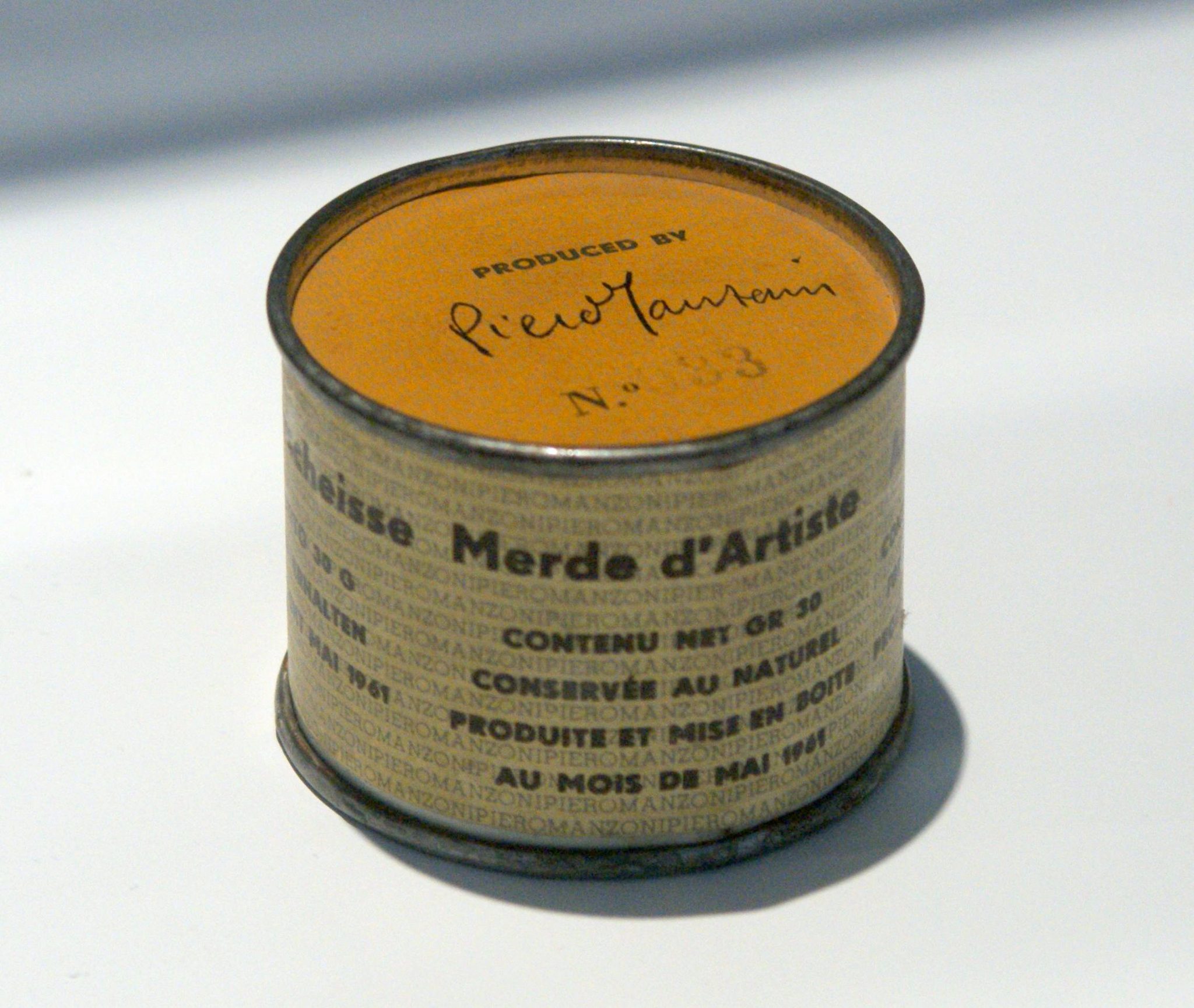
Beyond its ability to challenge our perception of art and beauty, what truly fascinates me about the work is its simplicity; it does not take skill to create the “Merda d’artista.” Instead, it takes courage and a creative genius to break from the norms and make art out of something as intimate as one’s feces. The intimate nature of the work forges a bond between the artist and collector, where Manzoni’s essence will forever be associated with the work. It criticizes a society lacking human connection and a consumer world that spotlights material goods and ignores the people behind their creations. It is commonplace for an art collector to have little to no direct contact with the artist. In this case, where the artist shares his intimacy, the work bridges this gap connecting the art consumer and art producer.
One of the primary criticisms of “Merda d’artista” is that it is a one-note joke that relies on shock value rather than substance. While this surface-level interpretation might be true for some, it neglects a deeper, more substantial interpretation of the purpose of “Merda d’artista” rather than just limiting it to a shocking joke. Moreover, the sealed, mysterious nature of the steel can has sparked numerous rumors that the can does not contain feces. Manzoni’s potent commentary has the audience questioning the very essence of what is valued in society. His ingenious, mysterious, playful, childlike creativity has created a magic aura behind the work that will forever be lost if the can is ever opened.
The seemingly shock-value-driven artwork “Merda d’artista” is an impactful testament to the very essence of art that has guided me throughout my life — its power to challenge, question, and redefine. While physically simple and seemingly crude, this provocative piece holds a complex narrative that explores the realms of societal values, the artist-consumer relationship, and the commodification of art. It’s a bold embodiment of the principle that art, at its core, is not merely about aesthetically pleasing creations but is also a vehicle for expressing thoughts and ideas that may be uncomfortable yet thought-provoking.