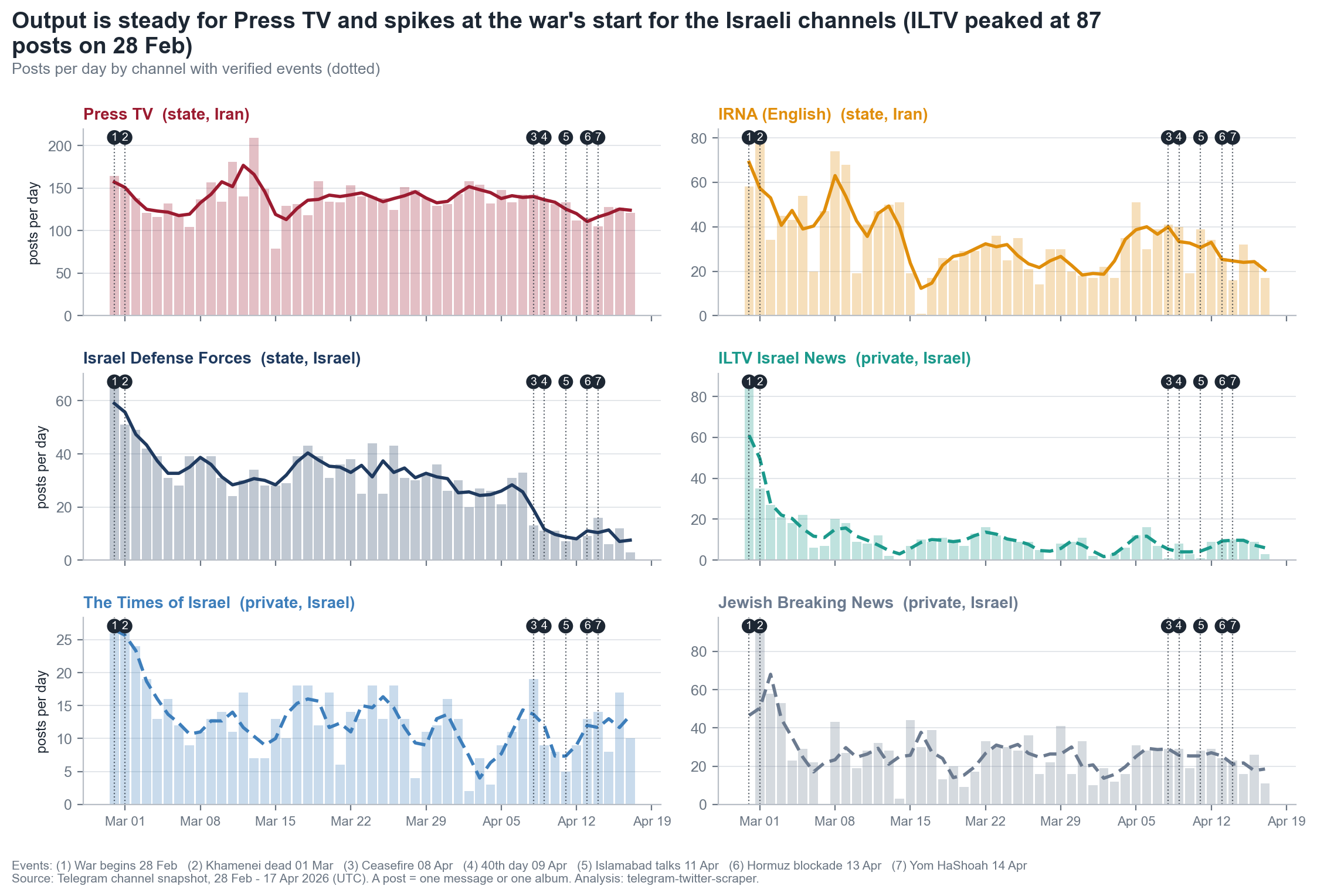
During the first seven weeks of the 2026 war between Iran and the United States and Israel, Press TV published 6,683 posts on Telegram. That is 136 a day, every day, day and night. The next busiest channel in this study, Iran's own state news agency IRNA, managed 33. The Israel Defense Forces' channel managed 29, and The Times of Israel 13.
It is tempting to read that gap, along with several others, as the signature of state ownership. This article tests that idea with a state channel on each side, Israeli as well as Iranian. The posting gap holds. Most of the other differences follow nationality instead.
Design
Six English-language Telegram channels, every post published between 28 February and 17 April 2026 (UTC), fetched on the same day with full text. A post is one message or one album. Iranian and Israeli outlets now each include a state channel, so ownership and nationality can be separated, at least in part.
| Iran | Israel | |
|---|---|---|
| State | Press TV, IRIB's foreign-language broadcaster; IRNA English, the state news agency | Israel Defense Forces, the military's official channel (a spokesperson, not a newsroom) |
| Private | No English-language private Iranian channel was available. This is the design's biggest gap. | ILTV Israel News; The Times of Israel; Jewish Breaking News (aggregator; ownership unverified) |
14,620 messages become 12,221 posts once albums are grouped. Press TV accounts for 55% of them. All intervals below are 95%: bootstrap over days for rates, Wilson intervals for shares.
Tempo: The One Gap That Holds
Measured over the same 49 days, Press TV out-posts every other channel by a factor of 4 to 12. Within Iran, it posts four times as often as IRNA, which is also state-owned. In Israel the pattern runs the other way: the state channel (IDF) posts at 0.58 times the combined rate of the three private channels (95% CI 0.51–0.66). State ownership alone does not predict a high posting rate.
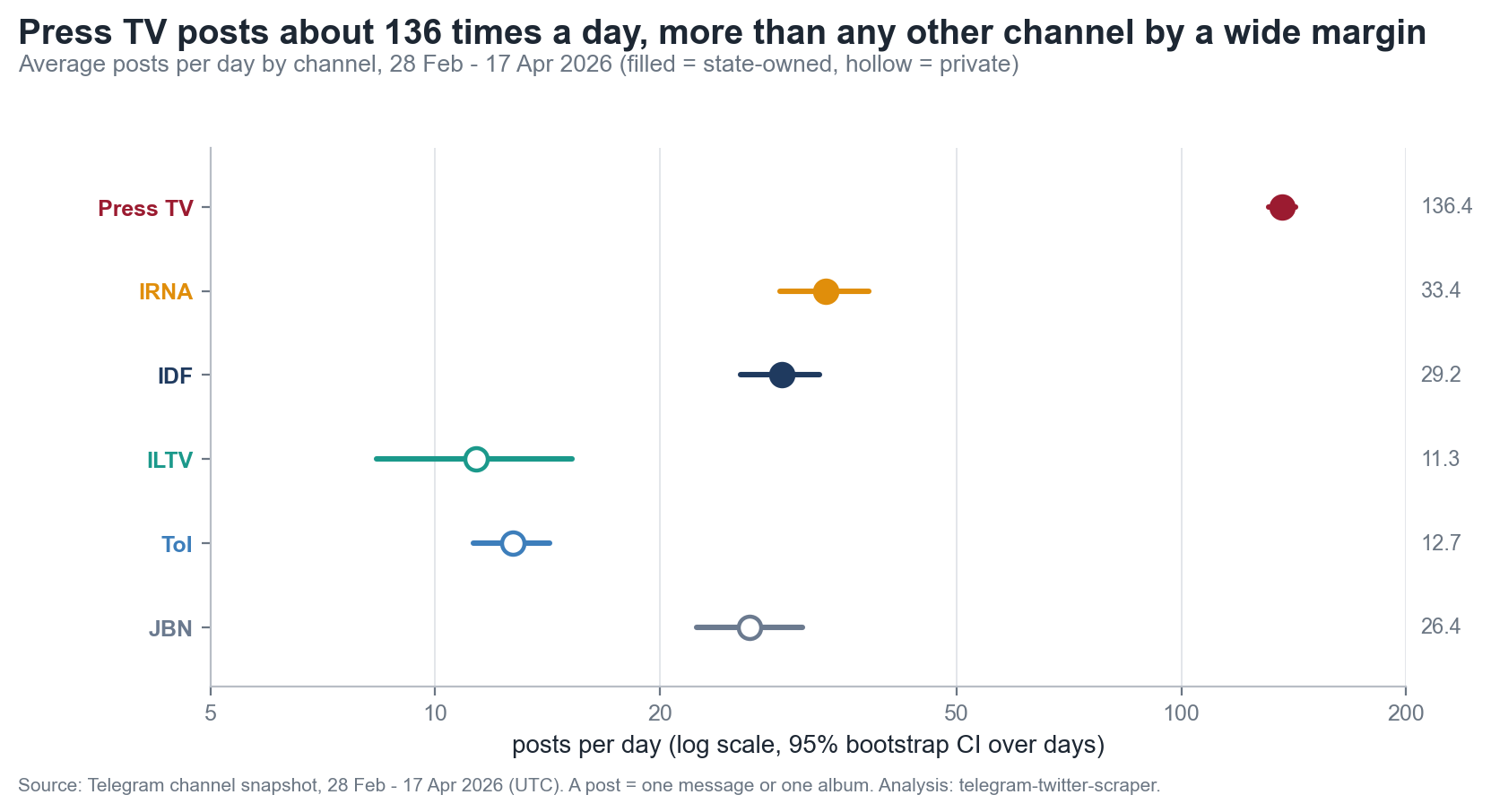
The table gives the multiples over the full window and over two single weeks in April. The gap is stable for IRNA, JBN and The Times of Israel; against ILTV and the IDF it widens in April, when their output fell.
| Press TV ÷ channel | 28 Feb – 17 Apr | 7–14 Apr | 10–17 Apr |
|---|---|---|---|
| IRNA | 4.1× (3.6–4.7) | 4.0× (3.5–4.9) | 4.7× (3.9–5.8) |
| IDF | 4.7× (4.2–5.3) | 9.4× (6.6–13.6) | 13.5× (10.1–19.0) |
| JBN | 5.2× (4.4–6.1) | 4.8× (4.4–5.4) | 5.5× (4.6–6.9) |
| The Times of Israel | 10.7× (9.5–12.3) | 11.3× (9.0–15.1) | 11.6× (9.1–15.6) |
| ILTV | 12.0× (9.0–16.4) | 21.2× (14.4–37.7) | 18.0× (13.1–29.8) |
Ratio of Press TV's posts per day to each channel's, with 95% bootstrap intervals. Source: notebook 02_tempo.
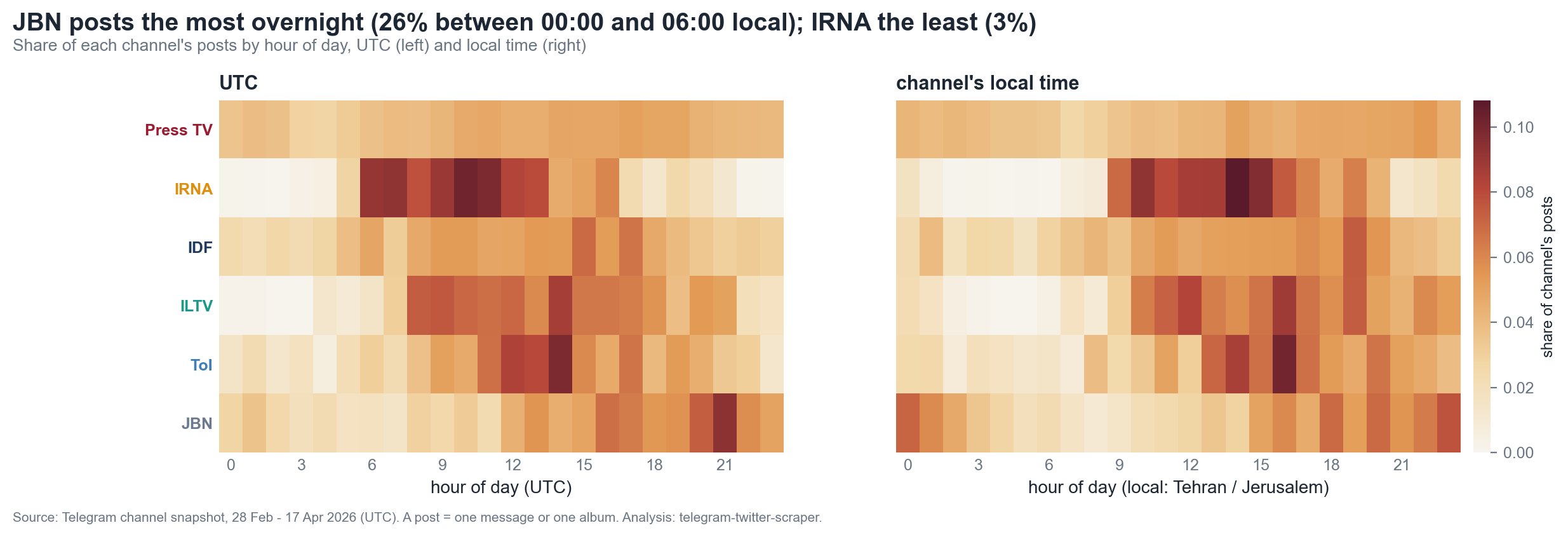
Its daily rhythm points to the reason. 23% of Press TV's posts go out between midnight and 6 a.m. Tehran time, against 3% for IRNA. IRNA keeps office hours for a domestic agency. Press TV runs an overnight shift for audiences in other time zones. This fits Price's (1994) account of international broadcasting as a contest for foreign loyalties. That is a story about mission, though, and not ownership as such. The fast Israeli aggregator JBN also posts 26% of its output overnight.
Agenda: Two National Conversations With a Shared Middle
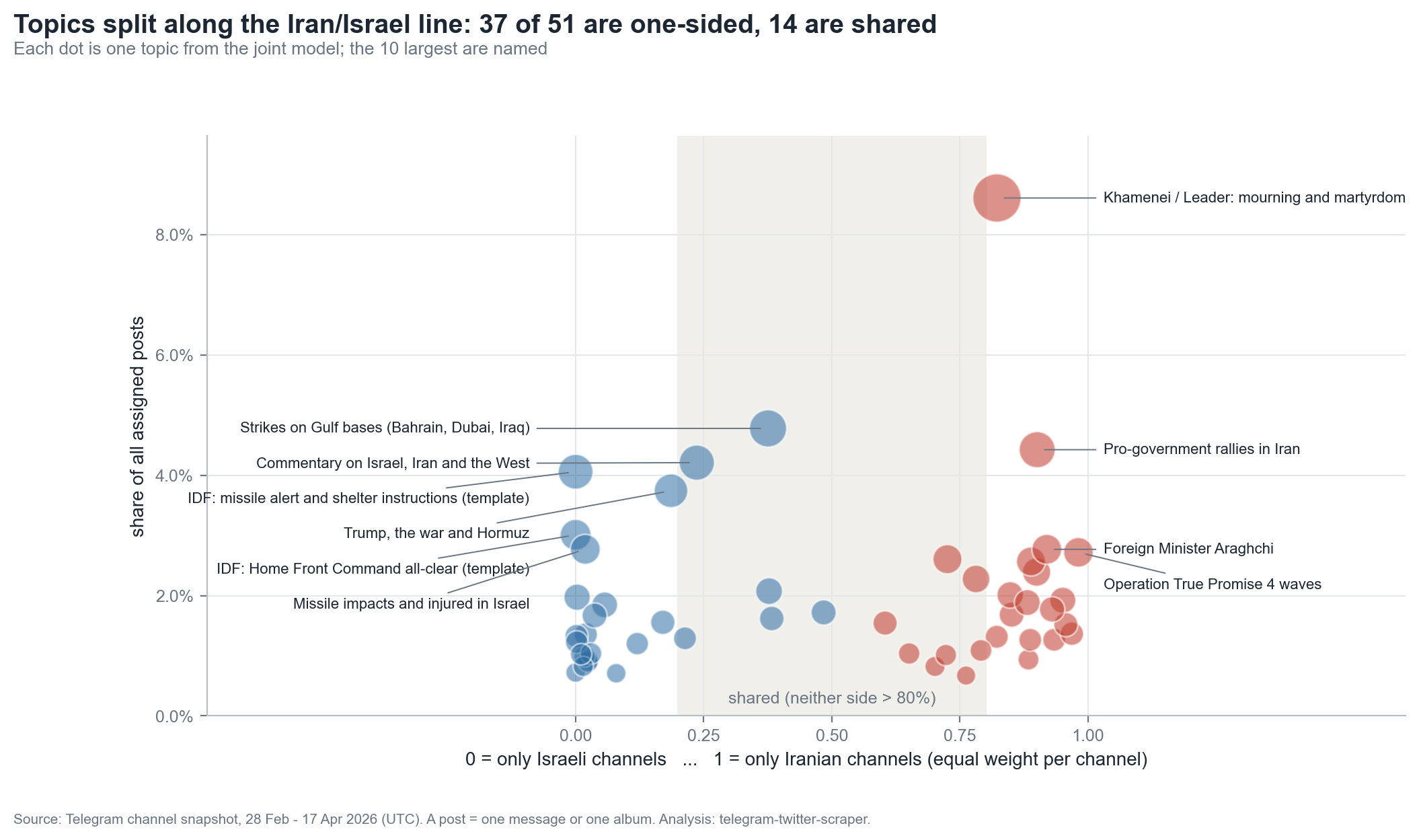
I fitted one topic model to all channels together, using the same embeddings and settings for every channel. It finds 51 topics and holds up across five random seeds (mean adjusted Rand index 0.91), though it leaves 34% of posts unassigned. Of the posts it does assign, 40% fall in topics only Iranian channels discuss, 33% in topics only Israeli channels discuss, and 27% in topics both sides cover. These include strikes on Gulf bases, Trump and Hormuz, and commentary on the West.
Press TV's coverage of the 40th-day mourning for Ayatollah Khamenei could be read as evidence of a state broadcaster doing legitimacy work that private outlets have no reason to do. The fair test is symmetric: does each country's media commemorate its own dead? It does.
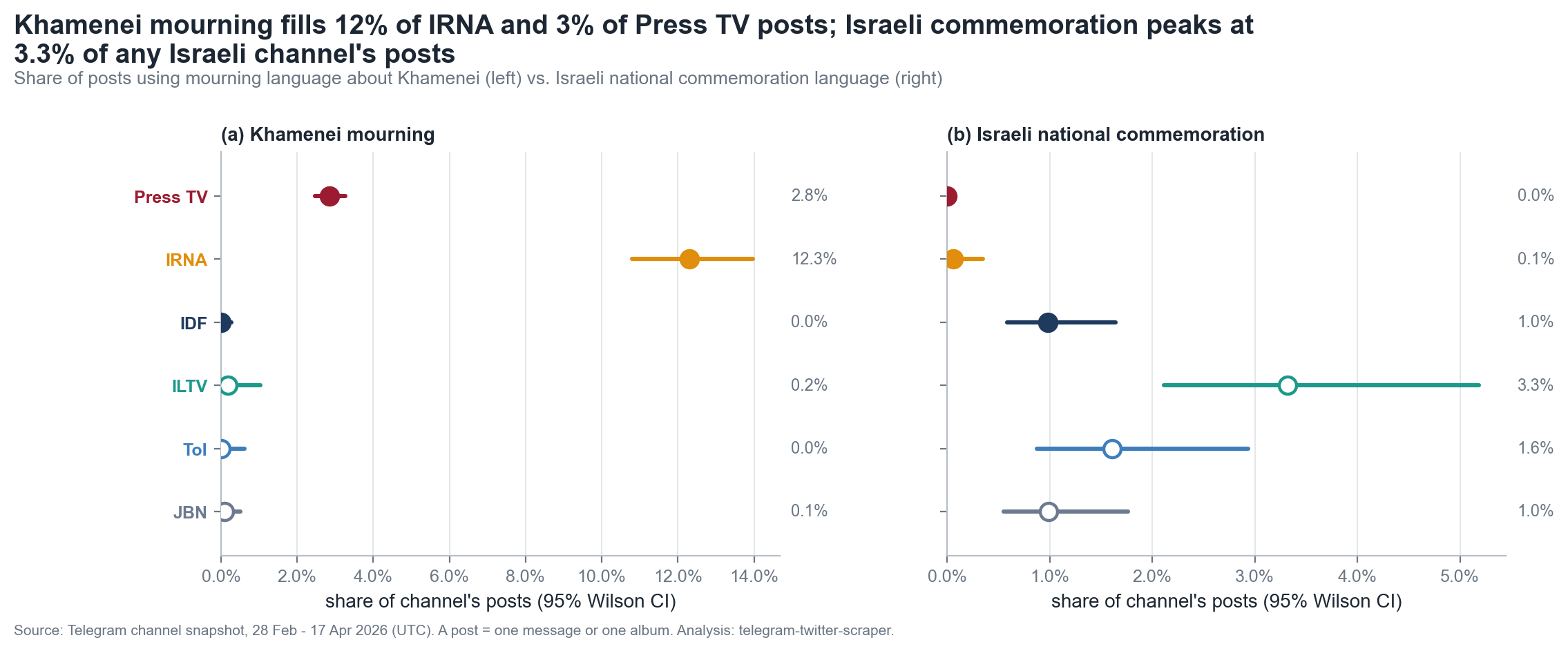
IRNA devotes 12.3% of its posts to Khamenei mourning, four times Press TV's 2.8%. No Israeli channel goes above 0.2%. Israeli commemoration language appears in 1–3% of posts on all four Israeli channels, state and private alike, and almost never on the Iranian ones. The topic model gives the same picture: a Khamenei topic holds 19% of IRNA's assigned posts and 10% of Press TV's, while a Holocaust-remembrance topic holds 10% of The Times of Israel's and 7% of ILTV's. Commemoration splits along nationality, not ownership.
Actors: The Same War, Framed at Different Distances From Washington
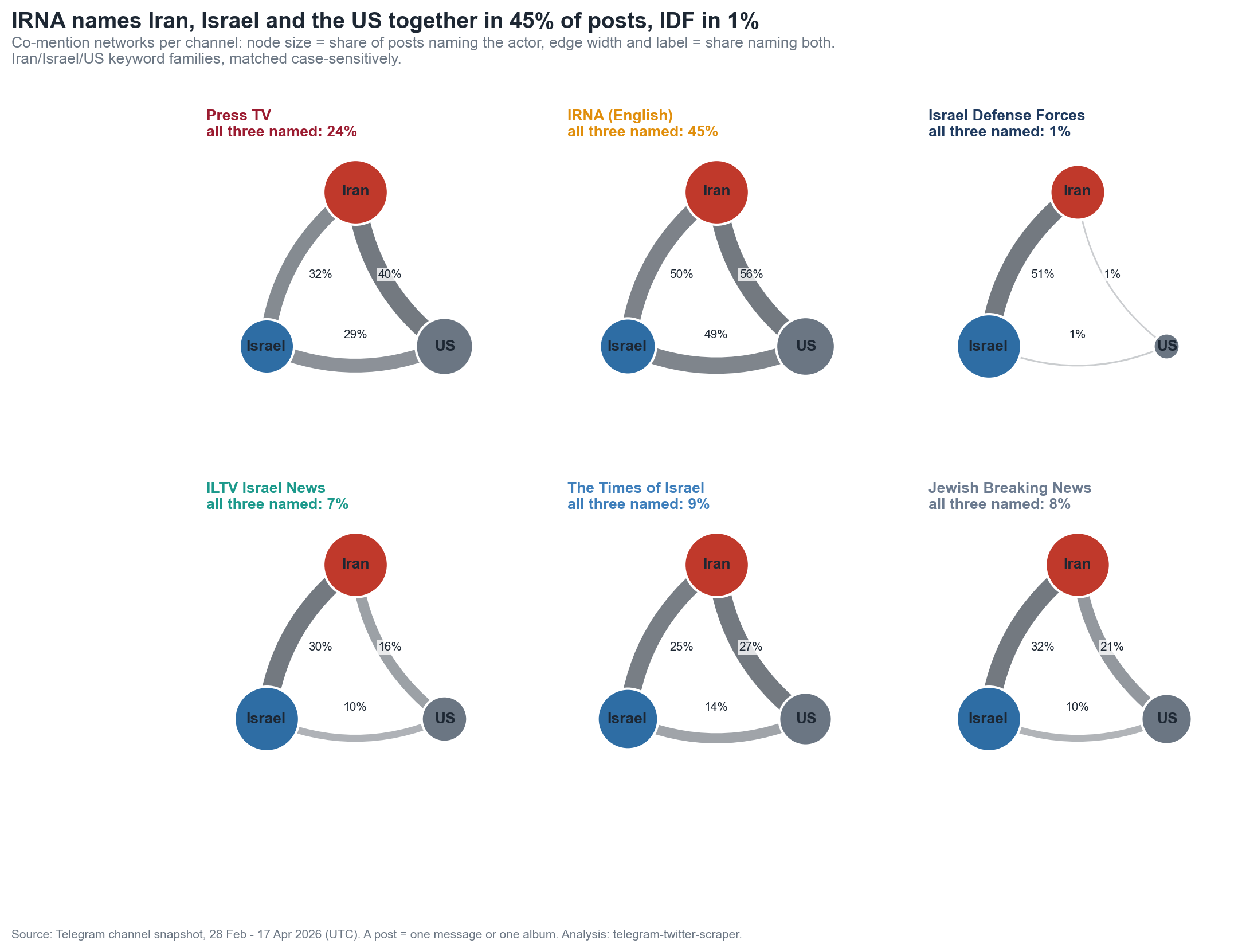
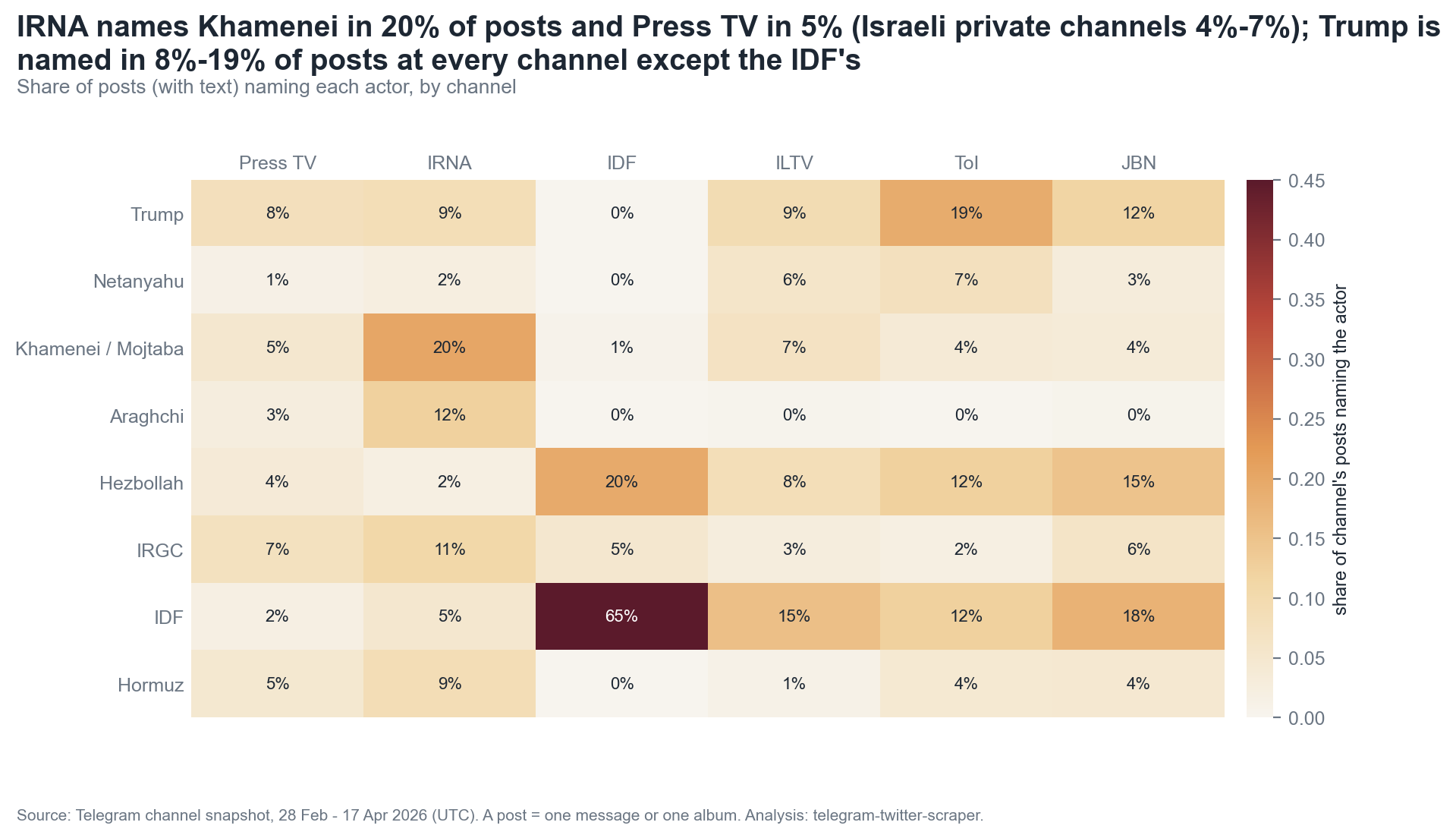
Iran is the most-named entity on five of the six channels. The framing still differs by side. The Iranian state channels tie all three countries together in one post far more often: 45% of IRNA posts and 24% of Press TV posts name Iran, Israel and the United States together, against 7–10% on the private Israeli channels and 1% on the IDF channel. Iranian outlets narrate a US–Israeli war on Iran. Israeli outlets more often narrate Israel's war, with Washington as one actor among several.
Media: Heavy Video Is Not a Press TV Signature
Coded correctly, Press TV is almost entirely visual: 48% of its posts carry video, 45% a photo, and only 2% are text alone. ILTV (52% video) and JBN (44%) look much the same. The Times of Israel attaches a photo to every post, and the IDF channel is 87% text. These are house formats, and they cut across both ownership and nationality.
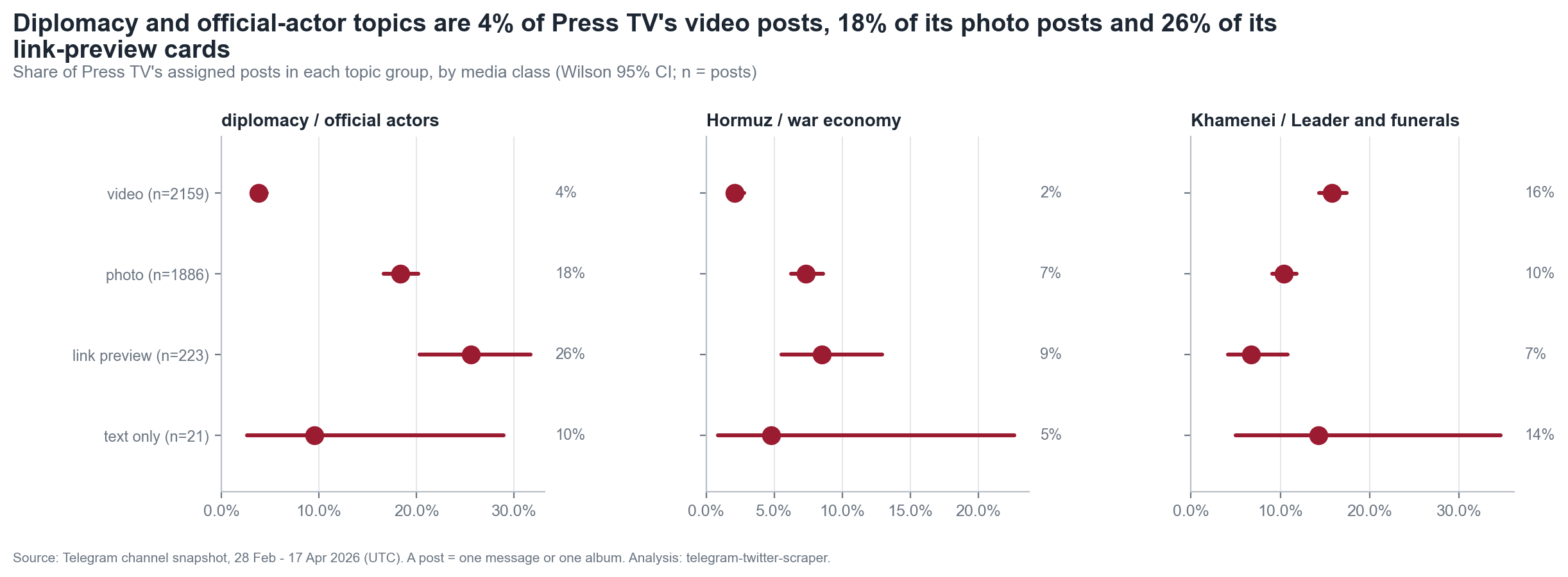
A soft-power reading (Nye, 2004) would expect Press TV to reserve its visuals for diplomacy and official actors. The pattern runs the other way. Diplomacy and official actors make up 4% of Press TV's video posts, 18% of its photo posts and 26% of its link-preview cards. Video is where the mourning, rallies and strike footage go.
Tone: The Instruments Failed Validation
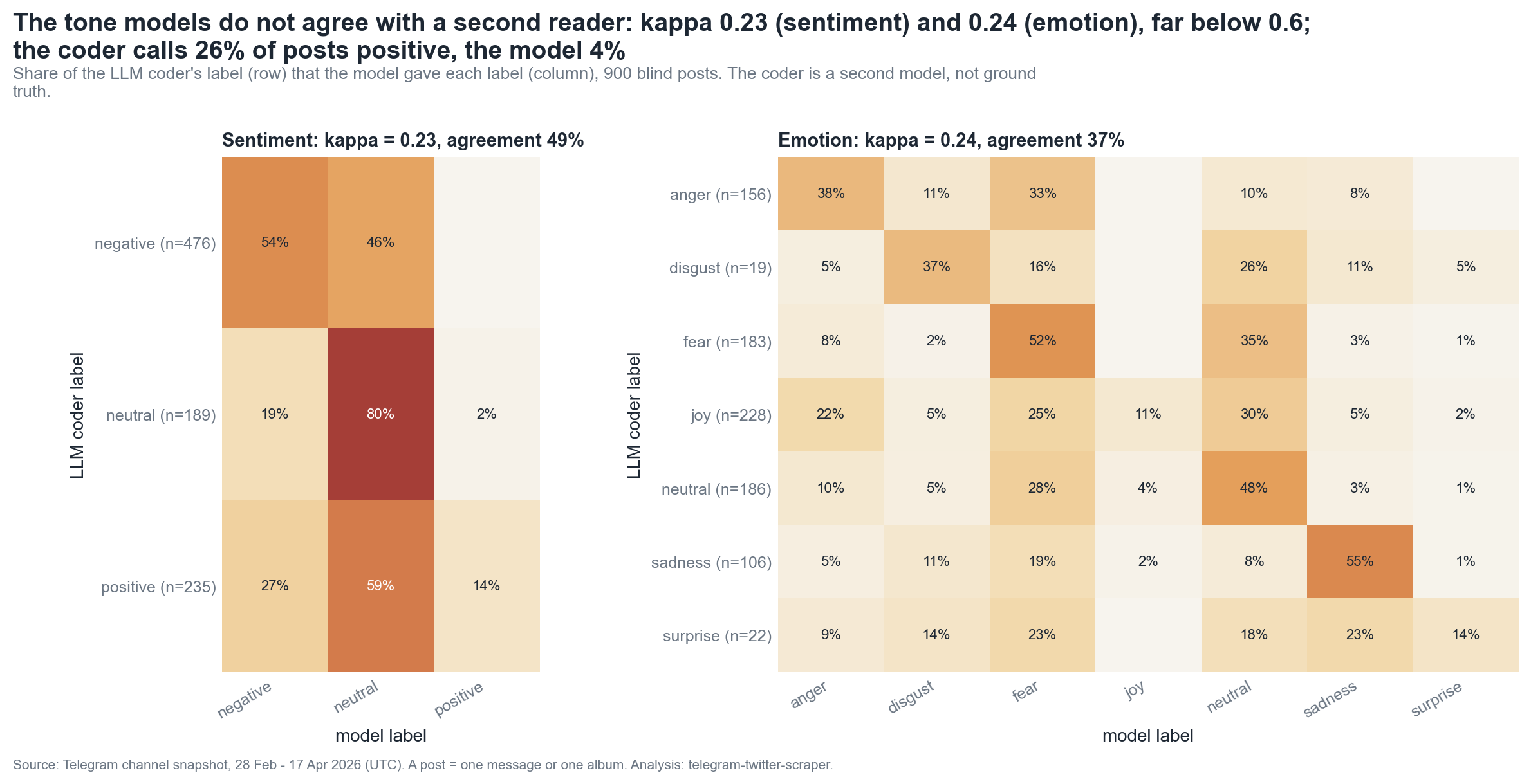
Off-the-shelf sentiment and emotion classifiers are the obvious way to compare tone, but they have not been checked against this kind of text. I drew a blind sample of 900 posts, 150 per channel with the channel hidden, and had a second coder label them. The second coder was a language model (three Claude Sonnet instances, 300 posts each), not a person. That makes it a check of agreement between two models, not a measure of accuracy.
The two readings barely agree. Cohen's kappa is 0.23 for sentiment and 0.24 for emotion, far below the 0.6 I set in advance as the bar for interpreting a label. On the IDF channel agreement is no better than chance. The disagreement has a direction. The classifier calls only 2–7% of posts positive on any channel. The second coder calls 15–45% positive, mostly triumphal strike claims and military communiqués that the classifier reads as neutral or frightening. I therefore make no claim about tone.
What Ownership Explains
| Axis | What explains it |
|---|---|
| Tempo | Mission, not ownership. Press TV is an outlier even among state channels; Israel's state channel posts less than its private ones. |
| Agenda | Nationality. 73% of assigned posts sit in one-sided topics, and each country commemorates its own. |
| Actors | Nationality, strongest at state outlets. Iranian state channels frame a triangular war with Washington; Israeli channels much less often do. |
| Media | House format. ILTV and JBN are as video-heavy as Press TV; video carries mourning and strike footage, not diplomacy. |
| Tone | Not measurable with these tools. Neither label passes validation. |
Hallin and Mancini's comparative framework, extended beyond the West in their 2012 volume, is more useful here for what the state asks of an outlet than for who owns it. Press TV's distinctiveness lies in its foreign-service mission: the overnight shift, the volume, the steady output through every phase of the war. On agenda and framing, the useful line runs between Tehran and Jerusalem, not between state and private. That is what news-value accounts predict when two national presses cover the same war from opposite sides (Galtung & Ruge, 1965). Herman and Chomsky's (2002) propaganda model describes convergence inside one market system. It says little about adversaries' media.
Limits
- One state broadcaster and no private Iranian channel. The IDF channel is a military spokesperson; 46% of its posts are exact repeats of alert templates. JBN's ownership is unverified.
- Commemoration, actor and triangle measures are keyword proxies with some false positives. A third of posts are unassigned by the topic model, and topic labels are hand-written summaries.
- View counts were read on 2 October 2026, months after posting. Some channels have days with no posts, and the snapshot cannot tell silence from deletion.
- The tone check used an LLM as the second coder. A human-coded sample is the next step before any claim about tone.
Methods and Reproducibility
Snapshot 2026-02-28_2026-04-18_20261002T081854Z, fetched 2 October 2026 with telegram-scraper snapshot; full text, media classified by Telegram media type, albums grouped by grouped_id. Notebooks 00_collect to 06_media in the telegram-twitter-scraper repository's notebooks/ folder reproduce every number and figure here; key results are collected in docs/study/findings.json. Embeddings: BAAI/bge-small-en-v1.5. Topics: UMAP to 5 dimensions plus HDBSCAN (min cluster size 50), one joint model, stability over 5 seeds. Tone: cardiffnlp/twitter-roberta-base-sentiment-latest and j-hartmann/emotion-english-distilroberta-base. Entities: spaCy en_core_web_sm. Rates use a day-level bootstrap (2,000 draws); shares use Wilson intervals; multiple tests are Benjamini–Hochberg adjusted.
Works Cited
- Cohen, J. (1960). A coefficient of agreement for nominal scales. Educational and Psychological Measurement, 20(1), 37–46.
- Galtung, J., & Ruge, M. H. (1965). The structure of foreign news. Journal of Peace Research, 2(1), 64–91.
- Hallin, D. C., & Mancini, P. (2004). Comparing media systems: Three models of media and politics. Cambridge University Press.
- Hallin, D. C., & Mancini, P. (Eds.). (2012). Comparing media systems beyond the Western world. Cambridge University Press.
- Herman, E. S., & Chomsky, N. (2002). Manufacturing consent: The political economy of the mass media (Updated ed.). Pantheon Books.
- Khiabany, G. (2010). Iranian media: The paradox of modernity. Routledge.
- Nye, J. S. (2004). Soft power: The means to success in world politics. PublicAffairs.
- Peri, Y. (2012). The impact of national security on the development of media systems: The case of Israel. In D. C. Hallin & P. Mancini (Eds.), Comparing media systems beyond the Western world (pp. 11–25). Cambridge University Press.
- Price, M. E. (1994). The market for loyalties: Electronic media and the global competition for allegiances. Yale Law Journal, 104(3), 667–705.
- Telegram channel posts, 28 Feb – 17 Apr 2026: Press TV (t.me/presstv), IRNA English (t.me/Irna_en), Israel Defense Forces (t.me/idfofficial), ILTV Israel News (t.me/ILTVnews), The Times of Israel (t.me/TheTimesOfIsrael2022), Jewish Breaking News (t.me/JewishBreakingNewsTelegram).