“They should rule who are able to rule best.” With these words, Aristotle posed a question that every generation must answer for itself: who decides who is most able, and how do we keep that decision honest? The framers of the United States Constitution offered their answer in the form of a social contract—a bargain in which citizens surrender a measure of individual freedom so that government can ensure the rule of law and protect their rights. By separating powers among the legislative, executive, and judiciary and binding all three in a system of checks and balances, the framers sought to prevent the concentration of power, promote citizen participation, and let the democratic process itself determine who is best fit to govern.1
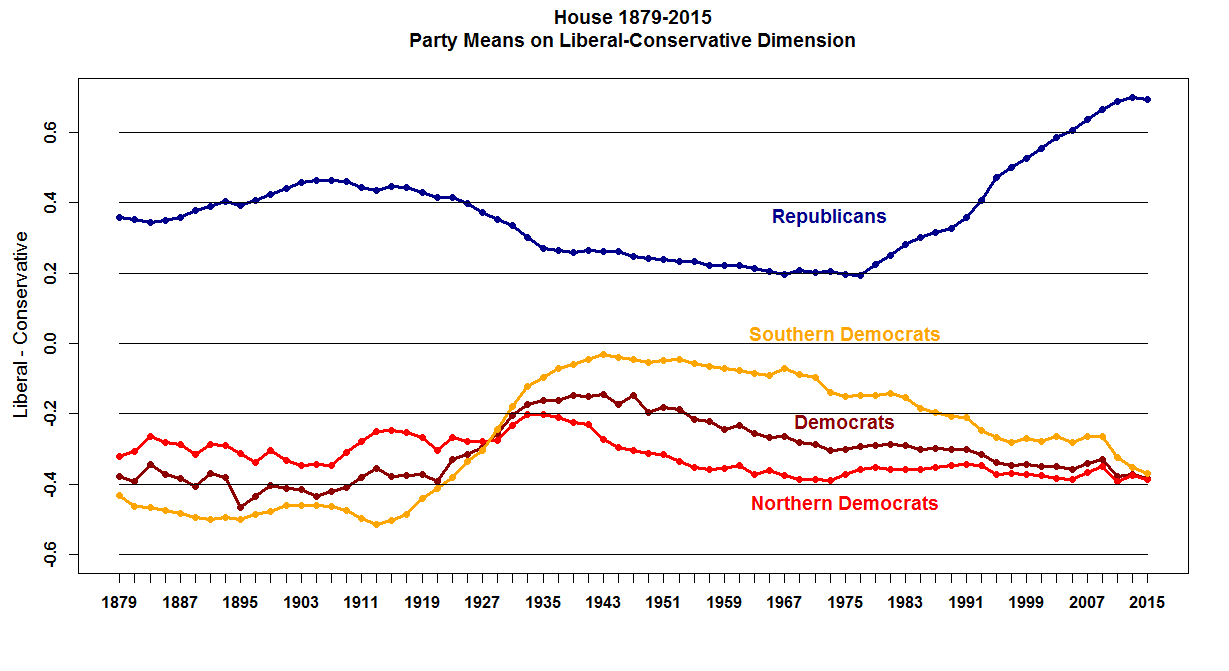
Even though the framers had the best intentions when creating the Constitution, nowadays, with political polarization at an all-time high, as shown in Figure 1,2 the very democratic process that aims to protect the rights of citizens and give power to those most capable of running government is vulnerable to manipulation and corruption. In modern times, democracies face a new challenge where “[d]emocratic backsliding today begins at the ballot box.”3
The Two Key Norms
In their book How Democracies Die, authors Ziblatt and Levitsky state two key norms as the necessary conditions for the healthy functioning of democratic governments: mutual tolerance and forbearance. Mutual tolerance refers to the idea that different parties accept each other’s legitimacy as rivals, and forbearance is when politicians exercise restraint when using their institutional powers.4 Without mutual tolerance, politicians delegitimize their political opponents, creating distrust in democratic institutions and disrupting the process of the peaceful transfer of power. Without forbearance, politicians can exploit their powers and suppress opposition, undermining the democratic process. Upholding these norms is essential for the maintenance of the rule of law, protecting the rights of citizens, and ensuring the longevity of democracy.
Gerrymandering is a clear example of an attack on mutual tolerance. By packing and cracking populations of individuals that vote alike when redistricting, the state legislature can manipulate the boundaries of an electoral constituency to favor a party. This violates the norm of mutual tolerance, disrupting democratic institutions—the state is not fairly represented—and delegitimizes political rivals, stopping opposing parties from taking power.
The filibuster is the most prominent example of how politicians can disobey the norm of forbearance. Through the unrestrained use of the filibuster, politicians can take advantage of their institutional power and prolong the debate on a policy decision, delaying or preventing a decision undermining the democratic process.
The Norms in the Constitution
In Article I of the Constitution, the creation of the legislative branch of Congress is a prime example of how the framers encouraged mutual toleration. The House of Representatives, structured to represent the country proportionally, allocates House seats based on state population; therefore, the most populous states have more seats. In this system, each representative has equal power, ensuring that the population is fairly represented and that diverse opinions from various communities can be heard. Moreover, the Senate is another example of how mutual tolerance is present in Article I. By giving greater power to smaller states, the Senate ensures that for legislation to be passed, parties have to work together and compromise. This system guarantees that various interests and groups within the country have a voice in the legislative process. The legislative branch acknowledges the importance of different viewpoints and encourages other parties to bargain, work together, and tolerate one another.
Even though the legislative branch naturally encourages mutual toleration by having different representatives with equal power discuss and negotiate policies, this can only occur due to regular and scheduled elections. Articles I and II of the Constitution mandate regular, scheduled, free, and fair elections for members of Congress and the Presidency. These elections serve as a way to institutionalize the peaceful transition of power and hold politicians accountable for their actions; if they do not adequately represent their community, they might lose their seat in the next election, and a more suitable representative takes power. Elections encourage mutual tolerance; they create periods where candidates can compete for power and periods where they have to cooperate, tolerating each other, to run the country. By ensuring power can change hands peacefully, the Constitution creates an environment where politicians know they have legitimate avenues of gaining power, encouraging mutual tolerance between rivals.
The most explicit example of the norm of forbearance being inscribed into the fabric of the Constitution is the concept of the separation of powers. To prevent any specific branch from gaining too much power, the separation of powers allowed the framers to create a system of checks and balances. This system ensures that no single branch can dominate by having them constantly supervise, check, and balance the actions of one another. This three-way tug of war creates a system of forbearance. If any branch decides to overstep its Constitutional power, it will be met with resistance from two other branches, discouraging excessive use of power.
Moreover, as the United States is a federalist country, the division of power between federal and state governments is another way the Constitution enforces forbearance. States have considerable autonomy, like the power to create and enforce their laws, collect taxes, and regulate commerce within their borders. This federal structure discourages the central government from overstepping its authority by ensuring that no single entity has complete control over the entire country, preventing the concentration of power, protecting individual liberties, and embodying the principle of forbearance.
Reinforcement of the Norms in the Modern Day
One of the best examples of the Constitution working to reinforce the norms of mutual tolerance in our modern day is the “Going Public” political strategy used by President Ronald Reagan. By reaching out to the public through a television broadcast, the president convinced the public to contact their representatives and ask them to support his Economic Recovery Tax Act of 1981. This political strategy utilizes the framework of Congress set up by Article I of the Constitution, where the public can pressure their representatives to make policy decisions. Here, the structure of the constitution has successfully worked to reinforce the norm of mutual tolerance, as the president recognizes his opposition and works directly with the public, convincing them of his policy ideas.
Even though Reagan and his “Going Public” strategy encouraged mutual tolerance, more recently, the presidency has recently taken a radical turn. This is seen with the January 6th insurrection, where rioters stormed the Capitol protesting the 2020 election results. By questioning the election’s legitimacy, former President Trump created distrust in the election process. Using his authority as president, Trump cast doubt on his opponent’s victory, creating distrust and disrupting the peaceful transition of power, violating both norms of mutual tolerance and forbearance. In this case, elections, as outlined in the Constitution, backfired against democracy as they do not account for the high levels of polarization seen today.
Another prime example of how the guardrails in the Constitution have backfired, this time against the norm of forbearance, was the Senate holding the appointment of the 2016 Supreme Court vacancy. The 2018 NPR article “What Happened With Merrick Garland In 2016 And Why It Matters Now” states that in a speech in Kentucky, Senator Mcconnell said: “One of my proudest moments was when I looked Barack Obama in the eye and I said, ‘Mr. President, you will not fill the Supreme Court vacancy.’”5 This quote clearly shows that Senator McConnell is defying the norm of forbearance. In this case, as a guard rail of the norm of forbearance through checks and balances in the Constitution, the Senate has the power to approve the appointment of a new Supreme Court Justice. As the Senate majority leader, McConnell has the authority to negotiate and approve the appointment. However, he is utilizing the full extent of his institutional power to stop the process, violating the norm of forbearance.
Constitutional Amendment
Another Constitutional guardrail that protects the norms of mutual tolerance and forbearance is the Constitution’s ability to amend. It provides a structured way to make substantial changes to the framework of government. However, this process requires broad consensus, encouraging a culture of mutual tolerance and forbearance, as significant changes cannot be made unilaterally or hastily.
A campaign finance reform is a plausible constitutional amendment to encourage the norms of mutual toleration and forbearance. The amendment would limit campaign contributions from all institutions and individuals by setting a uniform cap to ensure equality in political influence and implement full transparency in campaign financing, requiring detailed disclosure of all contributions and expenditures.
In an alternate timeline with this amendment, money’s political influence is greatly diminished. With a level playing field, candidates with less financial backing but strong public support have a higher chance to take office. This change leads to more diverse representation in all branches of government, bringing new viewpoints and fostering mutual tolerance. Furthermore, a shift away from politics dominated by those with vast financial resources incentivizes candidates to pursue policies that benefit their constituencies rather than major donors. This fosters a restoration of public trust where voters feel their voice matters as much as the wealthy, making them more likely to engage in the political process. This trust creates a buffer against extreme actions by politicians as they become accountable to a politically engaged and vigilant electorate, fostering a culture of forbearance.
Currently, money significantly influences politics and contributes to a severely uneven political playing field. Donors and institutions disproportionately influence political campaigns, creating a perception of corruption and reducing trust in the political process. This environment creates animosity between different political factions as financial power trumps democratic principles, leading politicians to violate the norms of mutual tolerance and forbearance.
The amendment to reform campaign financing can plausibly foster mutual tolerance and forbearance but would face significant challenges. Reducing money’s influence could lead to a more equitable political landscape where public opinion plays a more substantial role. This shift could encourage a more tolerant and forbearing political culture. However, the effectiveness of this amendment depends on its implementation and enforcement. There is a risk that financial influence finds new, less transparent ways to influence politics. Also, while this amendment addresses the financial aspect of political inequality, it does not target contributing factors to polarization, such as the media, partisan gerrymandering, and sociocultural divisions.
The amendment’s focus on finance might not fully target the deeper behavioral and cultural aspects of mutual tolerance and forbearance. It creates a more level playing field in politics; achieving a lasting change in political culture would require complementary reforms and a broader societal commitment to democratic norms. Nevertheless, it would be a step to ensure that “they should rule who are able to rule best.”
Works Cited
- Elving, Ron. “What Happened With Merrick Garland in 2016 and Why It Matters Now.” NPR, 29 June 2018, www.npr.org/2018/06/29/624467256/what-happened-with-merrick-garland-in-2016-and-why-it-matters-now.
- Levitsky, Steven, and Daniel Ziblatt. How Democracies Die. Penguin UK, 2018, books.google.ie/books?id=GmkwDwAAQBAJ&printsec=frontcover&dq=how+democracies+die&hl=&cd=1&source=gbs_api.
- Political Polarization. legacy.voteview.com/political_polarization_2015.htm.
- Robin, Corey. “How Do We Survive the Constitution?” The New Yorker, 4 Oct. 2023, www.newyorker.com/books/under-review/how-do-we-survive-the-constitution.
- United States Courts. “Separation of Powers in Action - U.S. V. Alvarez.” United States Courts, www.uscourts.gov/educational-resources/educational-activities/separation-powers-action-us-v-alvarez. Accessed 7 Feb. 2024.