What would a choice mean if the possibilities we reject continued to exist? Jorge Luis Borges gives this question two incompatible rhythms in “The Garden of Forking Paths,” first published in 1941. A spy thriller races toward an irreversible murder; a conversation inside it imagines time preserving every alternative. The story's force comes from the distance between those rhythms. An infinite universe does not make the life being lived feel any less urgent, or the act being committed any less terrible.1
The action takes place in England during the First World War. Yu Tsun, a Chinese former professor working for German intelligence, has discovered the location of a British artillery park. Captain Richard Madden is closing in, and Yu Tsun needs to transmit the place-name to his chief in Berlin. He takes a train to find Stephen Albert, an English scholar of Chinese culture. Albert has solved the mystery of a book left by Yu Tsun's ancestor, Ts’ui Pên: its apparently contradictory episodes describe a labyrinth of branching times.
Their meeting briefly offers recognition across national and cultural boundaries. Yet Yu Tsun kills the man who has restored his ancestor's work. The murder makes the newspapers, allowing his chief to read the victim's surname as the name of the town to attack: Albert. This ending makes the philosophical conversation inseparable from a question of responsibility. Can a person invoke the existence of other futures to excuse what he does in this one?
A History with Competing Voices
Borges begins with a reference to Liddell Hart's military history and an offensive delayed by rain. An unnamed framing voice then introduces Yu Tsun's signed deposition as evidence that will cast another light on the delay. The first two pages are missing. Before the confession begins, its authority is already qualified: we receive a document selected and presented by someone else, with part of its context unavailable.
The editor's footnote makes the conflict explicit. Yu Tsun initially suspects that Madden has arrested or murdered his fellow agent, Viktor Runeberg. The note rejects that account, identifies Runeberg by another name, and says that Madden killed him in self-defense while serving an arrest warrant. We have competing descriptions of the same death, with different implications for blame. The editor is a separate voice; the story does not establish that this person took down the deposition.
These layers concern how the past becomes legible. They do not, by themselves, prove that physical time is nonlinear. The pursuit still unfolds through telephone calls, train departures, walking, conversation, and arrest. Its suspense depends on minutes running out. Literary critic Robert L. Chibka emphasizes this forward pressure while examining the uncertainties in the story's historical framing and its different textual versions.2 Borges places a claim about many times inside a document that appears to record one sequence of events.
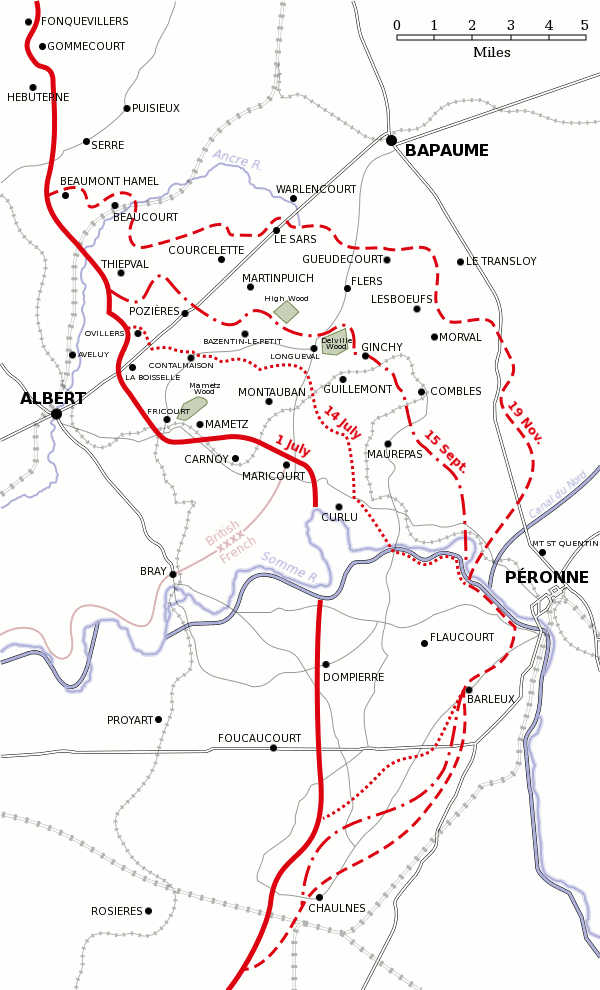
The map offers a useful comparison with the opening's documentary voice. A military account can organize places and dates with apparent precision while leaving out individual motives. Yu Tsun's confession supplies a private explanation, but his testimony is also interested and incomplete. Neither the map nor the deposition gives the reader an unrestricted view of the past.
The Book Is the Labyrinth
Ts’ui Pên was thought to have undertaken two projects: writing a novel and constructing a maze. His descendants found confusing manuscripts but no physical labyrinth. Albert's discovery is that the projects were one. What looks like a failed book becomes intelligible when the reader stops expecting every chapter to belong to the same continuous history.
In ordinary narrative, a decision selects an outcome and excludes alternatives. Albert explains that Ts’ui Pên's characters instead choose “simultaneously—all of them.” A character who dies in one chapter may be alive in another because the chapters belong to different temporal branches. Their contradiction is the organizing principle rather than an error to be corrected.

The maze plan clarifies the limit of the familiar metaphor. A visitor can retrace a wrong turn in a garden, and a surveyor can hold the entire design in view. Ts’ui Pên's book asks the reader to imagine alternatives continuing beyond each junction, with no final vantage point from which every history can be inspected. Albert's revelation changes the problem from finding the right route to understanding how incompatible routes can coexist.
Nor is the book merely a tree whose branches always separate. Albert describes times that diverge, run parallel, and converge. His example of convergence is local: Yu Tsun may arrive at the same house through different pasts, as a friend in one and an enemy in another. It does not follow that every path ends at the same destination. The possibility of reunion belongs to a network that also preserves difference.
A Garden Read Across Cultures
The setting makes Albert's interpretation more than an abstract demonstration. Yu Tsun approaches an English house through a garden while hearing Chinese music. Inside, objects and books connect places and histories that the war treats as opposed. An English scholar gives him access to a Chinese ancestor whose work his own family had dismissed. Understanding crosses the boundaries that military allegiance tries to enforce.
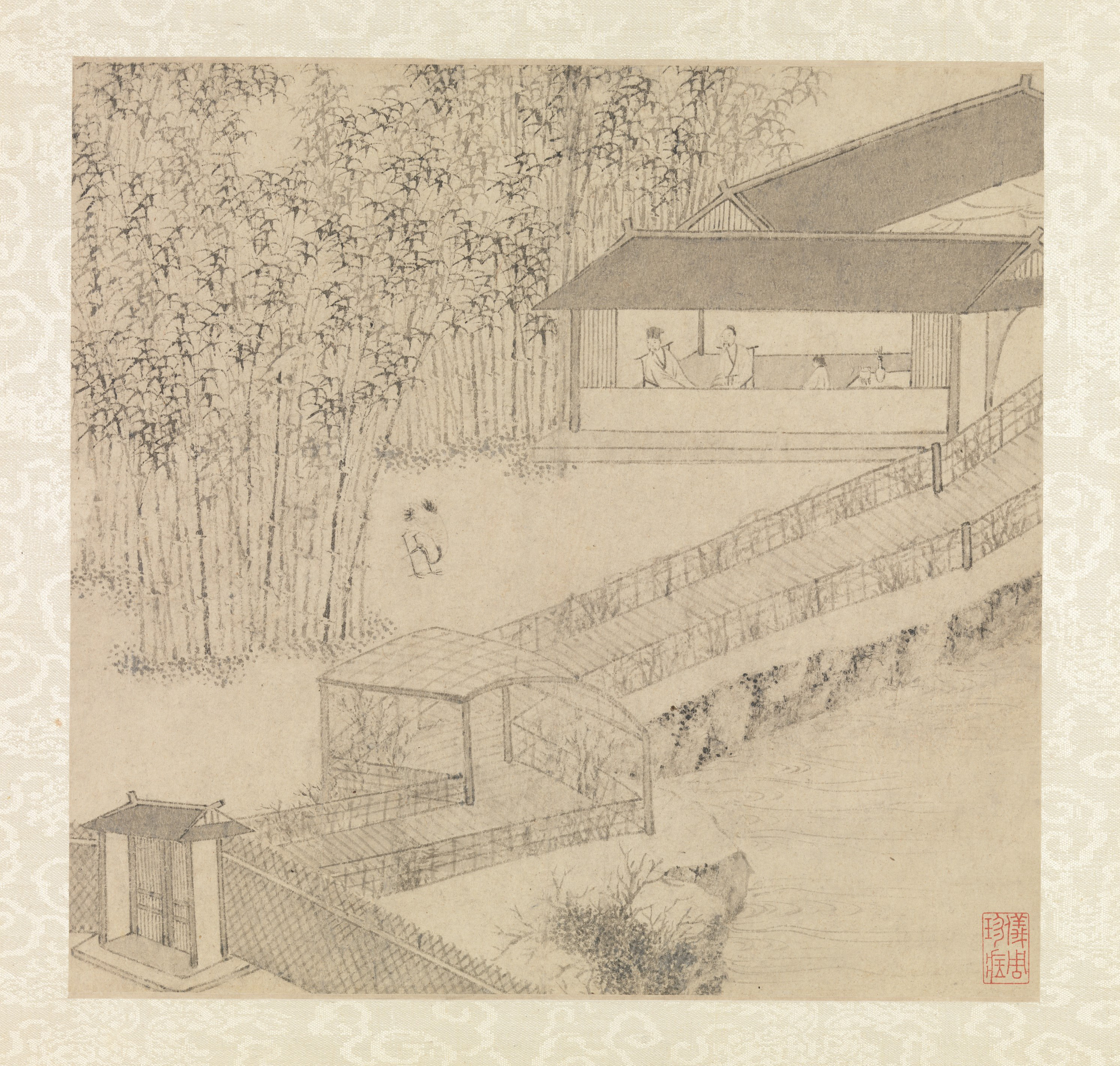
Wen Zhengming's album provides a concrete example of the relationship between a garden and its literary representation. The Metropolitan Museum describes its eight views as an integration of painting, poetry, and calligraphy.3 A garden can be encountered on paper through successive images and texts as well as by walking through it. That comparison helps us approach Albert's discovery without reducing the Chinese setting to an atmosphere of mystery. There is no evidence here that Borges used this particular album as a source.
Albert's hospitality also complicates Yu Tsun's motives. Yu Tsun says he cares nothing for Germany, but wants to demonstrate his ability to a chief whose racial contempt he resents. His service is entangled with the desire to prove himself to someone who devalues him. Madden, an Irishman serving England, is likewise described by Yu Tsun as acting under suspicion of disloyalty. These are the narrator's explanations of political pressure, not proof that either man lacks agency. The encounter with Albert opens another relation: respect sustained by reading rather than by obedience to a state.
Making the Future Feel Inevitable
Yu Tsun's account repeatedly presents his action as necessary. Yet one of his most revealing statements describes a technique for producing that feeling. He advises the perpetrator of an atrocity to “impose upon himself a future as irrevocable as the past.” The imperative matters. He must make himself treat the intended act as already settled, suppressing the hesitation that might prevent it.
This passage makes a simple fatalist reading difficult. Madden's pursuit imposes a deadline, but the decision to kill Albert serves a plan Yu Tsun has already formed before their conversation. He chooses an address from the telephone directory, calculates travel time, delays the shooting, and asks to see the manuscript again so that Albert turns away. These details show deliberate preparation. Describing the outcome as destiny can become a way of narrating one's own commitment to it.
Albert's warning that he and Yu Tsun may be enemies in another future acquires a terrible irony. It makes the murder imaginable without establishing that the murder is compulsory. The story presents the branching universe through Albert's interpretation of Ts’ui Pên, and through Yu Tsun's momentary sense of other selves around him. It gives us a metaphysical possibility, not an independent demonstration that every act is predetermined.
The tension is therefore sharper than a contest between free will and fate. Yu Tsun can contemplate alternatives while behaving as though only his chosen plan remains available. He succeeds at narrowing his practical future precisely when Albert has taught him to imagine its multiplicity.
A Person Reduced to a Place-Name
The ending depends on two acts of interpretation. Albert reads the contradictory novel as an intelligible structure. Yu Tsun's chief reads a newspaper murder report as military intelligence. Both discover meaning through a connection that other readers might miss. Their purposes, however, have radically different consequences: one recovers a work and honors its maker; the other turns a killing into instructions for another act of violence.
For the chief, Albert's name denotes a target. For Yu Tsun, it also names the person who welcomed him and understood his ancestor. The code works by discarding that distinction. A scholar's life becomes the vehicle for sending a word, and the successful transmission cannot preserve everything that the word now means to the sender.
Yu Tsun closes with “innumerable contrition and weariness.” His chief can decode the strategic message but cannot know the remorse behind it. The confession itself is another attempt to communicate what the newspaper could not convey. Military success and personal devastation occupy the same ending.
Borges leaves the many possible futures in tension with this particular loss. Other branches do not restore Albert within the history Yu Tsun tells. The garden enlarges what can be imagined, but imagination does not undo an action. A choice retains its moral weight because the life interrupted is the life encountered here, in the time one actually inhabits.
Works Cited
- Borges, Jorge Luis. “The Garden of Forking Paths.” Translated by Donald A. Yates. Labyrinths: Selected Stories & Other Writings, edited by Donald A. Yates and James E. Irby, New Directions, 1962. Publisher's collection page; online transcription of the story.
- Chibka, Robert L. “The Library of Forking Paths.” Representations, no. 56, Fall 1996, pp. 106–122. Text reproduced at eNotes.
- The Metropolitan Museum of Art. “Garden of the Inept Administrator,” Wen Zhengming, 1551, accession 1979.458.1a–ii. Collection record and curatorial commentary.
Image Sources
- Somme battlefield map: Gsl, based on A Short Military History of World War I — Atlas, edited by T. Dodson Stamps and Vincent J. Esposito, 1950. Wikimedia Commons source. Released into the public domain by Gsl; reproduced without alteration.
- Hampton Court maze: Unknown artist, “Labyrinth,” Encyclopædia Britannica, 11th ed., vol. 16, 1911, p. 33, fig. 4. Wikimedia Commons source; original article at Wikisource. Public domain in the United States; reproduced without alteration.
- Wen Zhengming garden album leaf: Garden of the Inept Administrator, 1551, ink on paper. The Metropolitan Museum of Art, Gift of Douglas Dillon, 1979. Collection record. Public-domain artwork supplied under the museum's Open Access / CC0 policy; reproduced without alteration.
Notes
-
Quotations follow Donald A. Yates's translation in Labyrinths. Other English translations use different wording; the analysis refers to scenes rather than assigning page numbers to an unspecified edition. ↩
-
Chibka examines the relationship between the story's documentary claims, historical sources, and variants in its Spanish and English texts. His discussion informs the distinction here between a chronological pursuit and an uncertain account of that pursuit. ↩
-
The museum's collection commentary identifies the album as eight views painted in 1551, following an earlier album of 1535. The comparison here concerns the garden's representation in an album, not a claim of direct influence on Borges. ↩